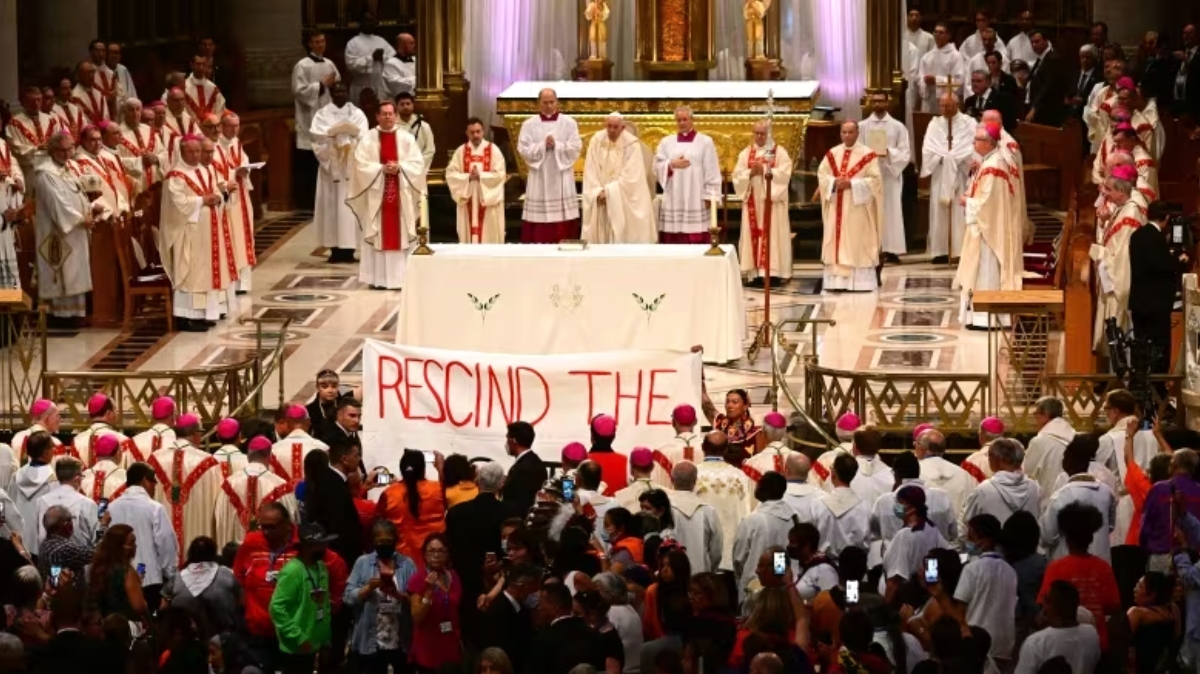
A decade after the Truth and Reconciliation Commission issued its final report, Canada’s political right is now leading an all-out assault on reconciliation.
Their effort takes many forms: from allegations that Indigenous people have the legal right to evict homeowners, to a growing cottage industry of residential school denialism that includes books, fodder for far-right opinion websites, a documentary and a university tour. A proliferation of subreddits and social media accounts boost anti-Indigenous content on a range of issues, from hysteria over the implications of the Cowichan decision, to industry propaganda Indigenous people are landlocking Canadian oil and gas resources, to conspiracy theories that evidence of unmarked graves at residential schools are part of an elaborate scheme to steal money from the federal government.
Canada’s far-right calls it the ‘reconciliation industry,’ though there’s no evidence anyone but conservative parties, pundits, and influencers are benefitting from it. The latest endeavour is a documentary called ‘Making a Killing: Reconciliation, Genocide, and the Plunder of Canada,’ which Rebel News says “challenges mass-grave narratives and exposes a lucrative taxpayer-funded industry.” The film is a production of the OneBC Party.
Perhaps the most insidious development in recent years is the church-burning narrative, an argument, based wholly on insinuation, that an apparent increase of fires at churches across Canada are somehow related to the discovery of unmarked graves at residential schools. While the other aforementioned anti-Indigenous narratives have remained mostly contained within Canada’s far-right, church burnings have become a key element of Canada’s mainstream conservative movement. Uncritical reports, occasionally from otherwise reputable sources, have elevated an otherwise disparate string of incidents into an apparent crisis, one that’s received considerable international attention.

Examining how these racist narratives were created and sustained, as well as how they interact with each other, is crucial to understanding how to defeat them.
On December 2nd 2025, Frances Widdowson, a former political science professor at Calgary’s Mount Royal University, was arrested for trespassing on the campus of the University of Victoria. She was accompanied by retired schoolteacher Jim McMurtry and OneBC leader Dallas Brodie.
The trio were there to promote residential school denialism among students by claiming the institutions were beneficial to Indigenous communities, and that reports of unmarked graves at the schools are part of a broad hoax.
Widdowson’s arrest garnered considerable attention from Canada’s far-right media, as she has become perhaps the most public face of residential school denialism. Conservative activist and former investor on CBC’s Dragons’ Den, Brett Wilson, reportedly offered UVic $100,000 to apologize to Widdowson.
Other sympathetic right-wing media, such as Juno News, misreported that the university told Widdowson she was not welcome on campus. In fact, the university told Widdowson in advance that she had not filled out the proper paperwork and there wasn’t sufficient time to ensure public safety and security for her event.

The Times-Colonist reported about 900 people gathered on campus to recognize the truth of the residential schools, an event organized in response to Widdowson’s planned appearance.
Widdowson’s residential school denialism is simply one manifestation of a larger trend in recent years of escalating anti-Indigenous racism in Canada. Though scholars like Sean Carleton argue the movement isn’t necessarily growing in size, the message is being amplified by far-right media and the broader conservative movement in Canada.
Arguments that evidence of unmarked graves at residential schools are a hoax often go hand-in-hand with claims that churches across Canada are being deliberately burned in acts of retaliation against the Catholic Church for his long history of genocide against generations of Indigenous people.
Speaking at a press conference in late-September, Conservative Party of Canada leader Pierre Poilievre vowed to crack down on church burnings, which he described as being terrorist acts. Poilievre further stated that “one hundred churches have been burned” though he did not specify over what period of time.
Although it appeared to be the first time anyone in Canada had called the alleged spate of church burnings “terrorist acts,” it was consistent with the exaggerated rhetoric used by conservatives to refer to the incidents, which so far have not been linked to each other.
If CSIS or the RCMP are investigating these events, they won’t say so publicly. According to CSIS spokesperson Magali Hébert, if a church is burned to achieve political, ideological, or religious violence, this may be considered terrorism and could be investigated by CSIS on a case-by-case basis. It isn’t clear whether these alleged arson cases would qualify individually, let alone collectively.

Similarly, the RCMP will also neither confirm nor deny any investigation into church burnings, though spokesperson Camille Boily-Lavoie downplayed the likelihood of RCMP involvement in a lengthy statement to Ricochet.
Among others, Boily-Lavoie said that the RCMP doesn’t systematically collect data on motivations related to arson, and that police don’t distinguish between types of religious institutions.
Boily-Lavoie added that hate-motivated crimes are investigated by the local police, but rarely cross the threshold to a national security threat.
While both CSIS and the RCMP indicated the reasons why they would be unlikely to investigate church burnings collectively, it is also known that both organizations have maintained surveillance of Indigenous communities. It isn’t known whether allegations of coordinated retaliatory arson attacks against churches have resulted in increased surveillance of Indigenous communities or of specific individuals.
As CBC News recently reported, Poilievre also stated that “Christians may be the number one group that are victims of hate-based violence. But, of course, it’s not politically correct to say that.”
Poilievre made the statement about a week after a century-old Ukrainian Orthodox Church northeast of Edmonton burned to the ground. As the CBC’s John-Paul Tasker notes, four other churches in Canada had been “set ablaze” up to that point this year. Tasker further describes the Ukrainian Orthodox Church as having been “torched during what police described as a crime spree — the latest in a series of arson attacks.”
Earlier in the article, Tasker mentioned an increase in hate crimes against Catholics had been recorded by Statistics Canada in 2021, which he then described as “religion-based violence that came after the Tk’emlúps te Secwépemc First Nation said preliminary findings from a radar survey of the grounds at the former Catholic-run Kamloops Indian Residential School indicated as many as 215 children could be buried on the site.”
CBC News is hardly alone, though it is perhaps unusual that the national broadcaster would be wading into territory normally occupied by the hard right side of the Canadian news media spectrum.
Tasker did not provide a source or supporting evidence linking the apparent increase in hate crimes against Catholics noted in 2021, and the discovery of soil anomalies by ground-penetrating radar at the residential school site. But the implication seemed to be that there was a causal relationship between the two: that an apparent increase in violence directed against Catholics was a consequence of the discovery of potential unmarked graves at former residential schools.
It seems plausible enough — indeed, it’s consistent with how CBC News has approached the issue of church burnings in Canada so far. In 2024 an article by Terry Reith calculated that 33 churches in Canada had burned since 2021, of which 24 were confirmed to be arson, resulting in charges laid in nine of the cases. It states that most of the cases remain unsolved and that no clear motive could be discerned in a majority of those cases. The article nonetheless strongly insinuated that the church burnings were deliberately motivated by the discoveries of potential unmarked graves at residential schools.
CBC News is hardly alone, though it is perhaps unusual that the national broadcaster would be wading into territory normally occupied by the hard right side of the Canadian news media spectrum. They too regularly insinuate the same connection, though they habitually offer even less evidence. Until proven otherwise, the incidents are separate and unrelated.
The idea that there is a spate of specifically anti-Christian arson attacks against churches in Canada has been amplified by many across the right-wing spectrum in Canada, one of whom is Conservative MP Jamil Jivani.
On September 28, 2025, Jivani posted on social media, “Another church in Canada was burned down this week (…) Christians, please take this seriously. Demand politicians take action to keep our communities safe from those who wish us harm.” Jivani was attempting to link a mass shooting and arson attack against a Mormon church in Michigan’s Grand Blanc Township with the burning of the Ukrainian Orthodox Church in Bellis, Alberta, which occurred in the same week. There is no evidence linking either event.
According to a recent statement from the FBI, the perpetrator of the Grand Bank Township attack, an Iraq War veteran, is believed to have been motivated by “anti-religious beliefs” against Mormons, though no specific details were provided.
Moreover, no explanation was provided for why a Ukrainian Orthodox Church would be the target of an arson attack if the attack was motivated by revenge for residential schools. The Ukrainian Orthodox Church in Canada was not involved in administering residential schools.

Jivani was most recently in the news for denouncing diversity, equity, and inclusion (DEI) principles — which he termed “Liberal racism” — at an Ottawa rally attended by dozens of people, mostly Conservative staffers. The Bowmanville—Oshawa North MP has been one of the major importers of Trump-styled far-right culture war rhetoric into Canada, alternating between screeds against DEI and arguing that Christians are under attack. Jivani often links the otherwise disparate ideas into a single narrative, as evidenced by a 2024 social media post in which he argued “we must protect Christians in Canada from governments and corporations abusing their power in our country, and from anti-Christian bigotry.”
Jivani, standing next to a Christmas tree, then argued that the federal government “wouldn’t lift a finger” to defend against anti-Christian bigotry, which he described as including “parental rights,” a codeword used by conservatives to resist LGBTQ inclusivity education, “conscience rights of healthcare professionals,” a reference to nurse Amy Hamm, who was disciplined by the B.C. College of Nurses and midwives for discriminatory and derogatory statements against trans people, as well as the apparent spate of church burnings. The post included a link to a petition Jivani was circulating that further complained of “government and corporate” overreach on DEI matters, while not doing enough to stop allegedly anti-Christian acts of violence and defend Christian charities’ legal status and freedom of expression.
“So much of contemporary Conservatism revolves around cultivating and validating a sense of victimhood in groups that aren’t actually victims.”
Jivani’s post was criticized by Canadian journalist Max Fawcett, who said: “So much of contemporary Conservatism revolves around cultivating and validating a sense of victimhood in groups that aren’t actually victims.” This in turn provoked the ire of Jivani’s friend and current U.S. vice president J.D. Vance, who said: “Canada has seen a number of church burnings in recent years thanks to anti-Christian bigotry.”
In the same social media post, Vance further stated that “Christians are the most persecuted religious group,” an idea reiterated by Pierre Poilievre more recently.
There is however no evidence suggesting that church burnings in Canada are linked to any specific ideology, let alone evidence of anti-Christian bigotry. There isn’t even sufficient evidence to call many of the incidents arson or hate crimes, a fact reflected in the careful and deliberate use of the term ‘church burning,’ even by those who appear motivated to indicate a causal relationship for transparently political purposes.
Moreover, even though right-wing politicians, pundits, and opinion websites frequently suggest hundreds of churches in Canada have been burned, in truth the figures are often inflated by including acts of petty vandalism. Jivani often throws in the term “desecrate” as well — as in “burned, vandalized, or desecrated” — though it has no specific legal meaning and is difficult to tell how desecration would be different from vandalism.
The figures are inflated as well by including fires that haven’t been officially determined to be arson, as well as fires that are known to have been entirely accidental.

An example of this is the fire that destroyed Notre-Dame-des-Sept-Allégresses Catholic Church in Quebec in 2024. Fire investigators could not find evidence of a criminal cause, and closed the file as the fire was likely accidental. Despite this, the fire is listed by Juno News as being among the “123 churches burned or vandalized since the residential school announcement.” Juno News further stated that “authorities have not released the cause of the fire” when in fact authorities had determined the fire’s cause was likely accidental. Juno News also provided no evidence to support their assertion the fire had anything to do with residential schools.
According to historian Sean Carleton, an expert in residential school denialism, the church burning narrative is a reaction by Canada’s right-wing to the evidence of the shameful legacy of residential schools — individuals who interpret this historical reality as an attack on the legitimacy of Canada.
“Look at the key players creating this content: Rebel News, True North (now called Juno News), National Post — what they’re doing is creating a backlash narrative,” Carleton said in an interview with Ricochet.
“They’re trying to use this as a distraction tactic to divert attention away from Truth and Reconciliation, from dealing with the truth that for over a hundred years the federal government colluded with churches to fund and administer a genocidal school system, undermined Indigenous language and culture, separated children from their families, and which resulted in large amounts of physical, sexual, emotional, and spiritual abuse that led to a number of deaths, including more than 4,000 deaths confirmed by church and state records.”
Carleton explained that the official death count is almost certainly an inaccurate underestimate given that there is likely a large number of records that have either been destroyed by church organizations or are actively being withheld.
“It’s basically just obfuscation,” said Carleton. “They’re trying to say ‘these attacks on Christianity are the result of fake announcements about graves being discovered,’ and the Liberal government is too weak to push back on it.”
“They’re trying to find as many different ways to discredit and delegitimize truth and reconciliation as possible, said Carleton, a historian of colonialism, capitalism, and education in Canada, who currently teaches at the University of Manitoba. Carleton argues that Canada’s right-wing is engaged in residential school denialism with the goal of trying to create a narrative that suggests residential schools were positive, the aim of which is to absolve Canadians’ feelings of shame and their sense of responsibility to call for truth and reconciliation.
Carleton points to a 2024 National Post opinion article by Terry Newman entitled “592 places of worship burned in 12 years. Liberals don’t give a damn” as an example of how Canada’s right-wing media is inventing a moral panic, largely by misrepresenting the facts, inflating figures, and implying a causal relationship between discoveries at residential schools and the apparent spate of church burnings.
“It’s basically just obfuscation,” said Carleton. “They’re trying to say ‘these attacks on Christianity are the result of fake announcements about graves being discovered,’ and the Liberal government is too weak to push back on it.”
But if you parse out Newman’s and other similar opinion pieces, and attempt to check the assertions they present as facts, you quickly find the argument falls apart.
“First off, not all of the 592 places of worship are Christian — they’ve included temples and synagogues,” said Carleton, arguing that lumping all places of worship together while clearly implying the attacks are against Christians is simply bad research.
Newman’s article featured a dramatic photo of Catholic Church burning, and in its opening paragraph she stated that there is an “epidemic of churches being set ablaze across Canada for years now — with attacks peaking after still unproven claims about graves of residential school children.”
Carleton says articles like Newman’s aren’t only insinuating a causal relationship when none have been proven, but are also providing highly inaccurate figures.
“They’re cooking the numbers by including graffiti and vandalism in the same category as arson,” said Carleton. “Or they’re calling it arson when actually the causes of the fires are not arson or are undetermined.”
Carleton notes the lopsided nature of much of the coverage of this issue — coverage that seems to increase the further the outlet moves towards the right-side of Canadian news media dial.
“Many of the sites that are doing this are openly right-wing Christian activists,” said Carleton. “They’re engaging in this type of discourse or rhetoric as a way to convince mostly their own followers. It creates this kind of siege mentality that is very convenient for fundraising, pushing out news articles, clickable content which produces ad revenue, they purchase books that these writers are often associated with — I mean it’s a whole anti-indigenous industry.”

To that point, prior to spinning off Juno News as a substack account, True North Centre was advertising “Grave Error: How The Media Misled Us (and the Truth about Residential Schools)” a residential school denialist book by Tom Flanagan and C.P. Champion. Juno News, along with Rebel News and the Postmedia newspaper chain, are the leading sources of residential school denialism in Canada.
“Pushing back against TRC is Canada’s anti-DEI,” said Carleton, who adds that even though there’s no evidence to suggest church burnings are related to residential schools or the discovery of potential unmarked graves, there is nonetheless intense frustration with the lack of justice to come out of the TRC process. Among others, the former Conservative government of Stephen Harper agreed to “forever discharge” Catholic organizations from their obligation to raise $25 million to support residential school survivors.
“We are at this moment in Canada’s journey of truth and reconciliation where the denialists are trying to deliberately confuse the truth, to close off the avenues to healing and justice and reconciliation,” said Carleton. “And this is just another tactic that they’re using to shift the blame from government and church to, now, ‘Christians are under attack.’”
Carleton argues the effort constitutes another kind of residential school denialism, in that those advocating the church burning narrative are grafting an unsubstantiated argument — that the church burnings are deliberate cases of arson and are forms of retaliation—onto the legitimate grievances of Indigenous people in a deliberate effort to delegitimize them.
“Pushing back against TRC is Canada’s anti-DEI.”
“They don’t want that truth to come out because it further implicates church and state and Canada and Christianity in the genocide of Indigenous people, and they’d rather change the conversation or create a distraction that allows people a way out of participating in truth and reconciliation,” says Carleton, noting that comments on articles on the subject published by Canada’s right-wing press tend to re-affirm common conservative talking points, either that Christianity is under attack or that knowledge about the residential schools is untrustworthy.
“True North, Rebel News — they’re using the tactics of the American far-right. They got Tucker Carlson and Matt Walsh to comment on church burnings,” says Carleton. “They’re using a successful right-wing approach to mobilize people against creating a better society and of re-entrenching racism as a normal, invisible, status quo.”
Carleton further notes that those arguing there’s a spate of church burnings in Canada are often the same promoting the “mass graves hoax” narrative, a related right-wing argument that evidence of unmarked graves at residential schools — which is almost always misrepresented as ‘mass graves’ — is a hoax.
“We are at this moment in Canada’s journey of truth and reconciliation where the denialists are trying to deliberately confuse the truth, to close off the avenues to healing and justice and reconciliation.”
In 2023, Carleton and Reid Gerbrandt, currently a sociology scholar at York University, published “Debunking the “Mass Grave Hoax: A Report on Media Coverage and Residential School Denialism in Canada” through the University of Manitoba’s Centre for Human Rights Research. The study concludes that, despite comments made (and since reiterated) in right-wing media that the overwhelming majority of news stories on discoveries of unremarked graves in 2021 used the term “mass graves,” in fact, 93.5 per cent of stories did not. The “mass graves hoax” narrative, the authors conclude, itself “hinges on a misrepresentation of how Canadian journalists actually reported on the identification of potential unmarked graves at former residential school sites.”
The authors describe the mass graves hoax narrative as an expression of residential school denialism, and that those who spread it are engaged in a “strategy of cherry-picking, of suppressing or distorting evidence to confirm a preconceived position.”
So it’s not surprising that those promoting the “mass grave hoax” are often the same promoting the idea that there’s an epidemic of anti-Christian motivated church burnings in Canada. Both are fabrications, both lean heavily into opinion rather than reported news, both distort available evidence to fit the established narrative, and both serve a very specific end.
“They’re cherry-picking. They’re using small amounts of evidence and confusing causation with correlation in the mind of people who don’t really know a lot, and who want to be allured to the ideas that residential schools were great and that there’s a conspiracy between the government and First Nations to make people feel guilty and drain away all this money,” said Carleton.
“People want to believe that kind of anti-Indigenous racism, it’s ingrained as part of the Canadian identity, unfortunately. And residential school denialists know this, and they tap into it for their own purposes.”