As he marks his 90th year, David Suzuki says he’s been looking back on his life’s work with mixed feelings and a heavy heart.
“I have failed,” said Suzuki, who recently joined host Adrian Harewood on Ricochet’s podcast In Bed with the Elephant to talk about his career and legacy as one of Canada’s most passionate champions for a livable future.
He says he’s ultimately failed to show the public that the economy is just a human construct based on extracting and exploiting our natural surroundings. “The problem is that we always seem to have to choose between the economy or the environment, and the environment loses every time.”
To many Canadians, Suzuki is perhaps best known as host of CBC’s The Nature of Things, and before that, host of CBC’s radio series Quirks and Quarks, and for his lifelong commitment to fighting climate change and environmental advocacy.
Is it too late?
When it comes to the climate crisis, in many ways, Suzuki said it’s too late to save most living species on Earth. Humanity has already pushed past critical climate tipping points, making gradual change likely impossible, and it’s certainly too late to prevent the world from continuing to heat up since humans are still pumping greenhouse gases into the atmosphere.
As Suzuki first told iPolitics, “If we pass one boundary, we should be shitting our pants. We’ve passed seven!”

The Earth has already passed seven of nine planetary boundaries that define the constraints under which human and other life exists.
After the first international climate conference in 1988, Suzuki said humanity had a chance to completely reverse course and solve the crisis. “If the world had followed the conclusions from that conference, we would not have the problem we face today and we would have saved trillions of dollars and millions of lives.”
Since then, wealthy countries like Canada have continued to do the exact opposite of what a consensus of global climate scientists have told us to do.
“I lie in bed twitching and just in real pain trying to imagine the world that my grandkids will grow up with, and I won’t even be here to fight for them. It’s agonizing to me,” he told Harewood.
Suzuki rejects selling false hope to future generations regarding the climate crisis — referring to it as “hopium.”
“I want to give them real hope. Real hope is based on confronting the reality that the science has been telling us for decades now,” he said.
Suzuki points to Finland, and says Canada should follow their lead with a similar call to action for citizens to begin preparing for climate disasters. Finland is calling on communities to familiarize themselves with their neighbors and the resources available to them, Suzuki said.

“There will be floods, there will be drought, there will be storms, and government will not be able to respond with the speed or the scale that is going to be needed when that does happen.”
“And if communities now work on their own resilience and their footprint, where are you impacting most in terms of the air, the water and soil, then can you get your community reduced to reduce its ecological footprint?” Suzuki said.
Thoughts on Mark Carney
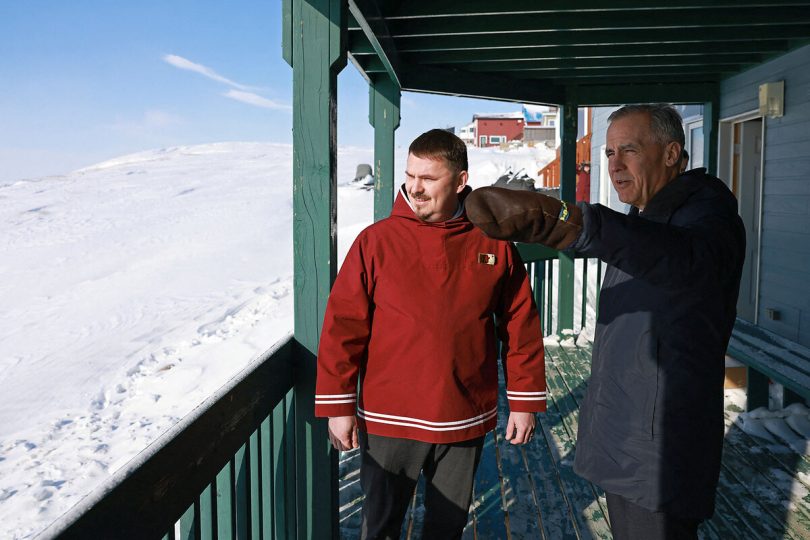
Suzuki has always been critical of politicians, and new Prime Minister Mark Carney is certainly no different.

What’s most frustrating for Suzuki, he says, is that he believes Carney understands the climate crisis, something that past prime ministers, most notably Stephen Harper, continuously questioned or denied.
Carney previously served as UN Special Envoy for Climate Action and Finance, has participated in numerous climate conferences, and discussed the climate crisis extensively in his book “Values: Building a Better World for All.”
So, while he understands the science and the global risks facing humanity at this moment, he is not acting with the urgency required.
Suzuki said Carney and all our leaders see nature as a resource to be sold and profited off of.
Nature is not separate from us, Suzuki said. We are part of nature, we are nature. We have air. Every breath we take is in us. There is no line between us and the air. It’s here surrounding us.”
Reflecting on life
In his younger years, Suzuki and his family faced significant challenges.
During the Second World War, Suzuki lived in a Japanese internment camp in British Columbia. His grandparents, on both sides, emigrated to Canada in the early 1900s but he never had a conversation with his grandparents, since they never learned to speak English, Suzuki said.
“So, my roots to Japan, I had to get them through my mom and dad, but my mom and dad were born and raised in Canada, never been to Japan. They were fluent in Japanese, but they were Canadians,” he said.

When the war started, Suzuki’s family were no longer considered “real Canadians,” and government documents even referred to them as “enemy aliens,” he said. His father was sent to a camp where he helped build the Trans-Canada Highway. while his mother and his two sisters moved to an internment camp.”
When the government finally offered compensation, Suzuki refused to accept saying it felt like a payout in exchange for never talking about the experience again. Suzuki calls his experience a failure on the test of democracy and should be a “trigger to think about other injustices.”
“No, I still feel the need to remind people of what happened to us. Not so that people feel guilty or any of that, but to understand the way our country behaves. And the greatest injustice, of course, is what we have done to the First Nations,” Suzuki said.
“We have to use our experience to remind people of what Canada claims to be, and we better live up to it.”
Listen to the full episode on YouTube, Spotify, Apple or wherever you get podcasts.