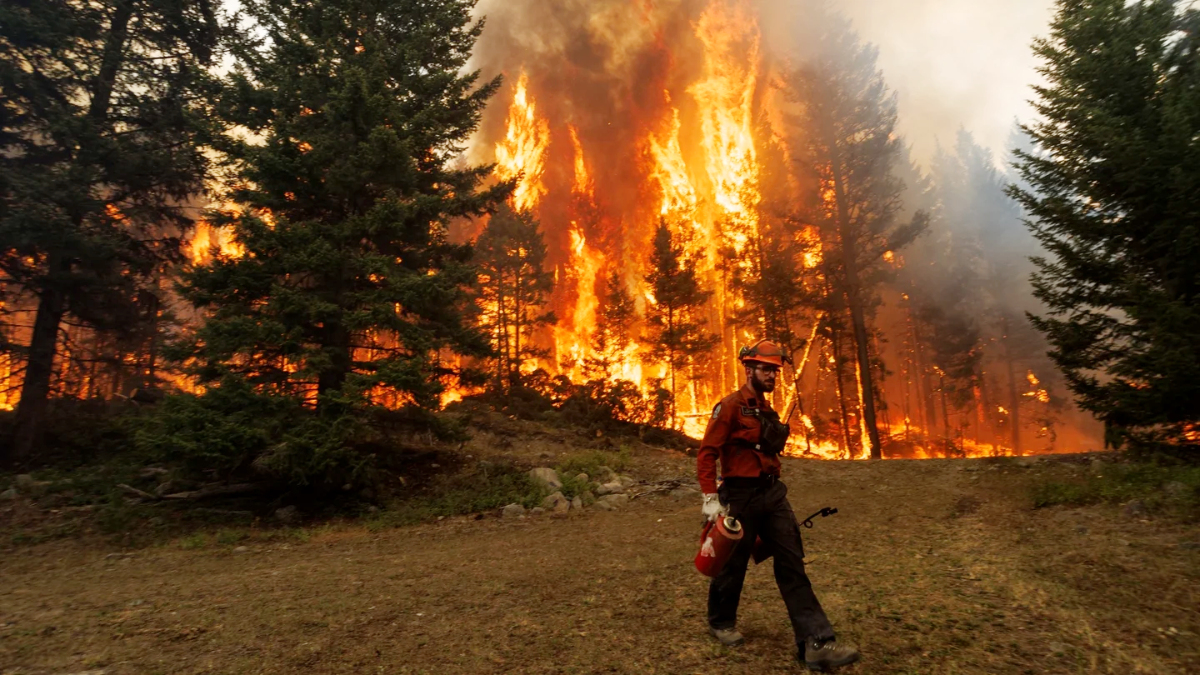
As wildfires swallow swaths of northern Ontario, in what is already the worst wildfire season in the province’s history, the union representing forest firefighters is sounding the alarm over what he calls “government mismanagement at the highest levels.”
Noah Freedman, vice president of Local 703 with the Ontario Public Service Employees Union, says from human resources to aircraft, the province’s culture of relying on surge funding to pay for forest fires is costing Ontario a lot more than money.
“What we’re talking about is government mismanagement at the highest levels,” Freedman says. “We have a lack of helicopters to get people to fires. We have a lack of crews to get people to these fires. The reason these fires ended up the way they did is, of course, 50 per cent climate change. But that 50 per cent, we can always account for. The government is aware that climate change is getting worse and they know how much worse it’s going to make this. The other 50 per cent is absolute negligence and mismanagement.”
It’s the second time this week that the Ford government has come under fire for its handling of the response to forest fires that are ravaging Northern Ontario. On Saturday, First Nations leaders on the route to the proposed Ring of Fire development blasted the government for failing to coordinate and leaving them without the information needed to make informed decisions about evacuations.
“Unfortunately, this fire situation was incredibly predictable,” said Tegan Hansen, senior forest campaigner at Stand.earth. “The models from both climate change, but also logging, forest management, have shown that we would be in this situation. People have been sounding the alarm on this, literally from coast to coast, for years.”
Lack of resources stretches capacity to fight fires
Freedman says even if Premier Doug Ford was correct when he reported that 150 fire crews were “on the ground” at a press conference in Thunder Bay on Saturday, that would still only constitute three-quarters of Ontario’s traditional staffing numbers. Freedman says the province has traditionally supported 200 fire crews of four members each, pointing out that Ford’s figure includes firefighters from Yukon and Alberta.
Ontario has exceeded its forest firefighting budget in four of the past five years, sometimes doubling allocated funding to pay for expenses. In 2024 and 2025, Ontario budgeted $135 million for forest firefighting while it spent $171 million and $271 million, respectively. In 2026, it budgeted $150 million, an increase, but still less than actual spending in previous years.

“When you don’t have the basic resources you need, you’re constantly trying to wiggle things in ways that the program was never meant to do. The people who make the larger decisions, these people are breaking their necks for almost no money trying to figure out how to rework all of these problems and all these years of government mismanagement into a workable system to protect the people of Ontario.
“But at the end of the day, we’re starting to see what it looks like when the program is stretched to the Nth degree and when things go wrong, which they obviously have.”
This is happening in Ontario, and in Quebec and also in British Columbia,” added Hansen. “In different ways, and in different forest types, but it’s equally devastating to communities.”
In the case of Fort Frances District, bordering Manitoba and Minnesota, OPSEU claims only three crews out of the allotted 12 were funded. Two major fires are burning in that district, which have ravaged parts of Quetico Provincial Park and cut the power to Gakijiwanong Anishinaabe (Lac La Croix First Nation), causing a full evacuation.
Freedman says there’s a direct line between chronic underfunding and the failure to control those fires. In the mid-1990s, Ontario experimented with different crew sizes to determine the most efficient and tactical structure. It decided on four-person crews with helicopters that can deliver them, plus 1,000 lbs of their gear.
The province has recently been running inconsistently-sized crews of sometimes five and sometimes six members. Then the province’s eight-year contract with Wisk Helicopters expired at the end of the 2025, and no new contract was signed with anyone to start the 2026 season. Freedman says that means districts are getting whatever aircraft are available at whatever price to the taxpayer, leading to inconsistencies and uncertainty in situations where precision is required.
“Ontario’s entire firefighting strategy is, get the fire while it’s small and get it fast. That is the only way you can reasonably control a wildfire,” he says.
“When you’re signing these short-term deals, you’re telling this company, ‘we need your machine that’s halfway across the country. We want it just for now, for five days, we might want it for longer. They’re charging you so much taxpayer money for the privilege of even moving that machine and hiring it on a short-term basis because for the [contracting] company, it has got to make the math [work].”
Wisk Helicopters did not respond to a request for comment. The Ontario government has not responded to multiple requests for interviews or comment in recent days.
The government was warned
As the Ministry of Natural Resources’ capacity to handle the forest fire load has been strained, the government had warning signs. Warnings appeared in Recruitment and Retention reports in 2015, 2018, and 2019. Those warnings culminated in the 2022 Office of the Auditor General of Ontario’s 2022 Value For Money audit, which anticipated that a likely 15 per cent increase in fires between 2022 and 2040 would require double the resources to suppress.

Then-Auditor General Bonnie Lysyk warned that incremental spending increases would be insufficient to adequately extinguish fires and respond to the increase in smoke and fire-related evacuations.
“Suppression will not keep pace,” she warned. “No silver bullet will resolve this.”
Facing pressure on Monday, Ford told the media he believes Canada ought to develop a federal wildfire strategy.
Freedman says Ford has had every opportunity to present that idea, and improve Ontario’s position within Canada. When British Columbia was hit with unmanageable fire seasons in 2017 and 2018, he points out, more infrastructure and human resources were arranged on a long-term basis because they responded to their knowledge that climate change was going to make the fires worse.
“It’s definitely a distraction mechanism. This government’s good at distractions,” Freedman says of Ford. “For sure, we could coordinate how we might be able to manage resources better but that’s not something you’re doing in the middle of a fire season. There’s no way anybody who has any insight into what’s going on at a provincial fire agency is going to be able to meet and be up for an honest conversation right now.”
As of Monday evening, MNR reported 140 active wildland fires across the northwestern region, 47 of which are classified as not being under control.
With files from Ethan Cox
Jon Thompson is a Local Journalism Initiative reporter based in Thunder Bay. Contact him with tips and story ideas at Jon@ricochet.media.