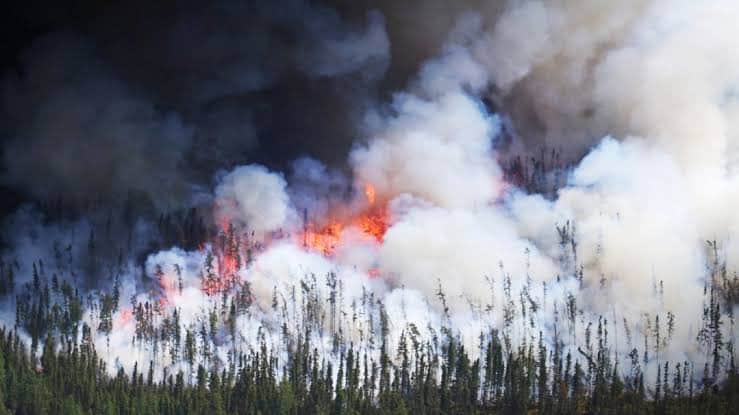
Wet ash is falling through a slight mist over the fly-in northern Ontario community of Eabametoong (Fort Hope First Nation), 370 kilometres northeast of Thunder Bay.
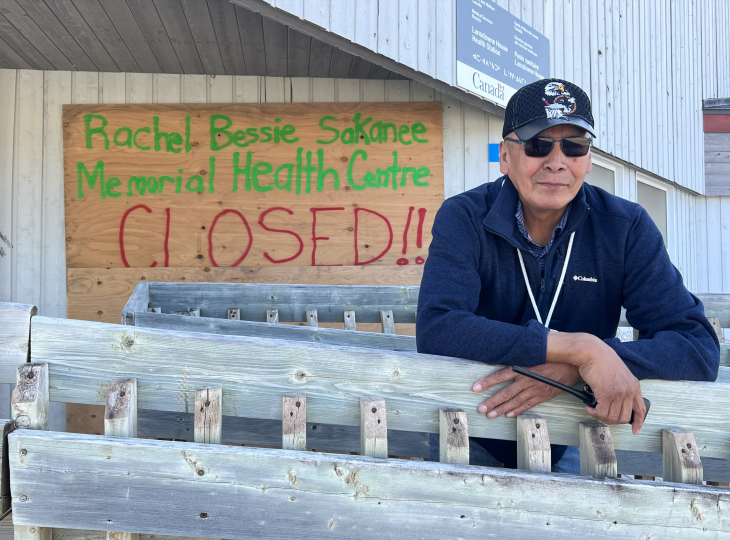
On Wednesday, a high column of smoke plumed over the lake. By Friday, Chief Sol Atlookan found fires surrounding his community, and now they’re burning right across the bay.
“It doesn’t matter where the wind’s coming from,” Atlookan says. “If it comes from the east, from the west, we’re still going to be smoked out. A lot of people are very nervous, of course. At this point in time, getting us out doesn’t seem to be a high priority.”
Saturday marked the third day Eabametoong’s elders and vulnerable have waited for evacuation as the smoke has thickened around them. Smoke has grounded planes at the closest airport in Nakina, 175 kilometres south.
Locals are using every resource to protect what they can, but Atlookan says he submitted flight manifests days ago and those at risk of health complications have to get out now.
While the governments of Ontario and Canada have been pushing for mineral development in the territory, including a proposed 5,500-square-kilometre deposit to the northeast known as the Ring of Fire, Atlookan has been at a loss to explain to his members why they couldn’t get either government’s attention before the fires and smoke trapped them in.
“It’s sad the way indigenous communities are treated in northwestern Ontario. They [governments] push their weight with their legislation so they can get access to what’s right here in Fort Hope,” he says, his voice strained. “They want to treat us like shit? When something happens to our families with this situation, it’s not funny anymore – it never has been funny.”
In a press conference in Thunder Bay on Saturday afternoon Patty Hajdu, the local Liberal MP and cabinet minister, who was shuffled out of the Indigenous Services portfolio last year, told journalists that vulnerable people from Eabametoong would be getting airlifted out today.
Matawa, the tribal council representing eight First Nations dotted across the mineral-rich region, declared a state of emergency on Thursday. They’re demanding improved communication with senior levels of government, and calling for the Canadian Armed Forces, the Red Cross, and the Canadian Rangers to be on standby for immediate deployment.

No fuel, no food, no clean water
Only 70 kilometres north of Eabametoong, Neskantaga (Landsdowne House First Nation), declared its own state of emergency and ambition to evacuate the entire community on Friday, as fires loomed 10 kilometres down the Attawapiskat River and smoke seeped through the walls of older homes.
Planes were grounded in Nakina until Saturday, when the first flight finally left with 14 elders. The supply service chain has been cut off from Pickle Lake as well, where highways are closed, fibre lines have been cut, and nearby communities are evacuating. No medicine has been getting in, no fuel, no food, and no bottled water for the First Nation that has been under a boil-water advisory for 11,491 days.
“Everything is impacted – services, medical,” says Neskantaga Chief Gary Quisess. He has been intending to evacuate the entire community but now he’s not sure, and says Ontario isn’t giving him enough information to make informed decisions. Quisess’s plane was turned around in the air on its way home from AFN meetings due to smoke. A family with an infant on that flight who happened to be out of the community to receive health care found themselves stranded at the Thunder Bay Airport, with all hotel rooms in the city full. They are lodging with volunteers for now, but Quisess says this isn’t sustainable.
“It’s a disaster. We need people to step up. We need the province to step up. We need the Canadian Armed Forces to bring their Hercules.”
Neskantaga was among the most vocal opponents of Ontario’s Bill 5 legislation last summer, which allows the province to designate “special economic zones,” for development, within which any regulation can be bypassed. Like his neighbours in Eabametoong, Quisess says Neskantaga is seeing public messaging that’s out-of-step with the response and support offered when crisis hits.
“Fast-tracking economic zones? That’s not going to happen,” Quisess says, mocking the government’s ‘Protect Ontario’ advertising campaigns. “I’m not seeing anyone working on the drug epidemic. I’m seeing people signing the agreements – bribery agreements, I call them. But until the prosperity is in the community, where’s the protection? Protect Ontario? What is that?”

Driving through the night in a school bus
Aroland First Nation Chief Sonny Gagnon personally drove a school bus of elders and vulnerable members 15 hours through the night to evacuate to Sudbury. He said multiple fires were tearing closer to his community and throwing heavy smoke, with no helicopters monitoring it or bombers fighting it. Gagnon is an experienced firefighter but he says Ontario wouldn’t advise him whether to evacuate. He felt forced to make the call, based on only what he could see with his own eyes and his son’s drone.
Members who were struggling to breathe had already filled four ambulances, driving 65 kilometres south to the Geraldton hospital. At 11:30 p.m. on Wednesday, Gagnon contacted his council.
“We have to move.”
“There was no contact [with Ontario] until such time as we started raising concerns,” Gagnon says. “Chief and council never had any updates as to what it was like. I would go do a visual [inspection] on a daily basis just to measure how far and how fast it was moving. And I never got no reports from them at all, to be honest with you.”
It’s a challenge many First Nations leaders say they’ve faced, including Kiashke Zaaging Anishinaabek (Gull Bay First Nation) Chief Wilfred King, who told the Assembly of First Nations this week that he made the same choice as Gagnon, when the province refused to advise him whether Gull Bay should evacuate.
Gagnon has been a consistent, visible Indigenous leader in Ontario’s press conferences and public appearances regarding the community access road to Ogoki (Marten Falls First Nation), which the province visualizes as the first of three legs in its “Corridor To Prosperity” highway to the Ring of Fire.
He says this experience has soured him on what he thought was an improving relationship with a government that will need Aroland’s free, prior, and informed consent for major projects in their homelands to proceed.
“The very same people who will say ‘yes’ or ‘no’ to the Ring of Fire (Aroland members) are the ones who rode the 15 rugged hours and I’m telling you, these highways are totally despicable,” he says. “I really appreciate the City of Sudbury for taking us in and the hospitality.
“But I’ll be calling [Premier Doug Ford] and [Indigenous affairs minister Greg] Rickford. They want to put a shovel in the ground to build a road to Marten Falls — and it’s looking kind of doubtful right now because of their lack of assistance. When situations like this happen, you know, they want to take, take, take, but they don’t want to give, give, give.”
Even the provincial representative for the riding claims the province carved her out of conversations about real-time events. While Namaygoosisagagun (Collins) burned to the ground with members fleeing by boat without notice, and people descended on Thunder Bay from Whitesand First Nation, Gull Bay, and Armstrong, Thunder Bay-Superior North NDP MPP Lise Vaugeois said no one in the government would even tell her office where they were going. The opposition member accused the Progressive Conservatives of playing politics with lives at stake.
“This is an emergency, this has to be above partisanship. We’re trying to help people,” Vaugeois said. “How am I supposed to do my job?”
Jon Thompson is a Local Journalism Initiative reporter based in Thunder Bay. Contact him with tips and story ideas at Jon@ricochet.media.