Ontario will not commit to holding an inquiry into its response to the worst forest fire season on record, despite calls from every opposition party and First Nations leaders whose communities are still under evacuation.
Responding to media questions about an inquiry at a press conference Thursday, Minister of Natural Resources Mike Harris confirmed his staff will conduct a “very deep dive” internal review, but he won’t commit to making its results public.
“Once we get through the fire season, just like we do after every fire season, we go through what’s happened well, what hasn’t worked the best with our teams, and we look to change those things for the following season,” Harris said. “I’m not sure how the review will all work out. We do a very deep dive internally and I think there will be lots of recommendations that will come forward and we’ll see what makes sense to talk about.”
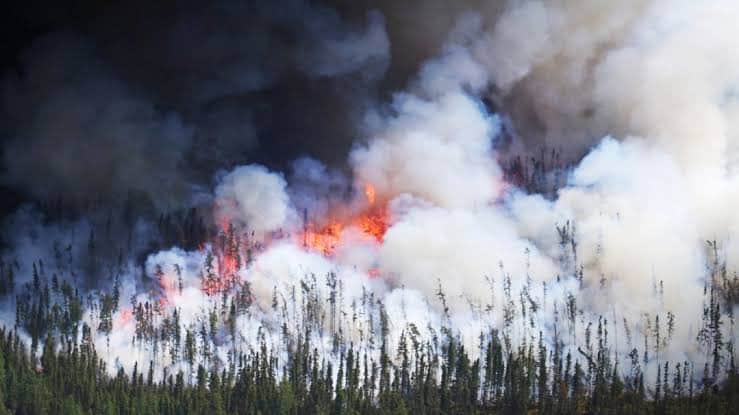
Harris’s public remarks painted a picture of a turning tide in the northwest, where crews and supporting aircraft from Mexico to Yukon and Newfoundland to Alberta were beating back the 90,000-hectare fire in Quetico Provincial Park and Thunder Bay 36, Ontario’s largest-ever-recorded fire that has burned 313,930 hectares and swallowed entire communities.

Indigenous affairs minister Greg Rickford spoke publicly for the first time since First Nations chiefs near the proposed Ring of Fire mining development called for his resignation, as they claimed the minister has failed to contact leaders of evacuated communities.
Rickford said he was speaking with First Nations leaders who were not speaking publicly about their adverse experiences with his government, and that his staff was applying their feedback to future planning.
“We are actively doing discussions with First Nations leaders at various levels to ensure that in real time, we are nimble, and that as circumstances change for other communities, we can continue to do better,” Rickford said.
“Some First Nations leaders have chosen to have those meetings with us in private, choosing not, of course, to take this to the media, but rather focus on the safety of their community members, engage in best practices, whether it’s readiness suppression or the processes within evacuation and repatriation. And to that extent, I can attest to the fact that all of us as ministers have taken those conversations and those meetings and as the minister says, we always debrief and try to understand how governments can do better.”
First Nations leaders hold duelling press conference
First Nations leaders countered with their own press conference in the afternoon to reiterate their call for a provincial inquiry which has since been backed by the opposition NDP, Green Party, and Liberal Party.
Those First Nations insisted they be part of an ongoing conversation, and help to provide solutions.
Cat Lake First Nation Chief Russell Wesley accused the ministers of “avoiding a lynching” by throwing the morning’s press conference, calling the emergency calls he has been holding with the government “chaos.”
He said a public inquiry with formal roles for First Nations leaders is the only way to restore faith in the system and ensure that improvements will be made.
“We are in crisis, not just First Nations but Ontarians in general. There were municipalities that were evacuated,” Wesley said. “To say we don’t have a problem, yes we do have a problem: Ontario is burning and there’s no end in sight — and there’s no strategy.”
Fire approached Cat Lake from the north on July 13, as another blaze to the south burned through 12 hydro poles and shorted out the power. A third fire to the east blew across a highway, cutting both internet and telephone signals. Cat Lake, 180 kilometres northwest of Sioux Lookout, is one of 14 First Nations and municipalities that has been evacuated. Over 2,000 people are still waiting to receive notice that it’s safe to return home.
Wesley argued Ontario is thwarting First Nations who are trying to get involved and help improve Ontario’s firefighting system, and trying to be a part of the planning for climate disasters that disproportionately impact them. He pointed to the Nishnawbe Aski Nation forest firefighting plan, which Grand Chief Alvin Fiddler personally handed to Doug Ford in 2021. Fiddler said the premier gave no response.

The Cat Lake chief and former provincial bureaucrat then offered his own 12-point plan to improve firefighting in the remote north.
Wesley’s list includes having First Nations lead alongside shared provincial and federal jurisdiction teams; long-term funding, including economic recovery and compensation; building capacity with Indigenous guardian and fire stewardship programs, as well as having First Nations involved in transportation, emergency shelter and mental health supports; recognition of Indigenous cultural burning; establishing a remote community resilience fund that would invest in firebreaks, emergency water systems and backup power, as well as local wildfire data and early warning systems; climate adaptation strategies; and dedicating a portion of forest and natural resources for wildfire prevention, emergency management and climate adaptation in First Nation territories.
He also wants to see annual reports independently report on and review response times, funding levels, community preparations and the impact of fires.
“It’s not like we’re ranting and raving about the problem that we have across the nation. We also have solutions,” Wesley explained. “The thing is, we have a treaty partner that refuses to listen.”
For two federally-unrecognized First Nations that have burned to the ground, an inquiry would serve as an autopsy to explain what has been lost, in hopes of the province and local communities learning from the mistakes.
Whitewater First Nation Chief Pauline Drake confirmed on July 19 that the largest fire in Ontario history had decimated 30 years of construction efforts. Satellite imagery showed fire had consumed the entire area around her fly-in community, located 250 kilometres northeast of Thunder Bay, but she waited for the photos to know for sure.
“It’s gone. We have to start from scratch,” she said, describing texting in shock with float plane pilots, tribal council staff and local MNR representatives at the last minute.
“There was no warning, really. Just ‘get out.’”

Drake noted that northern fires will worsen with accelerating climate change, adding that for First Nations people, the loss of land is spiritual and cultural; it’s necessary for survival. She asked the government to meet and actively look to the medium term, where practicing controlled burns and monitoring lightning on a hyper-local level will be essential to ensuring fires can be kept under control.
“Maintaining a healthy forest requires knowledge, commitment, and political will,” Drake said. “In the era of climate change, when longer fire seasons are more extreme, the weather’s getting intense. And it’s becoming the norm, and we must remain focused and remain resilient and be strong and work together as a nation. We are all one people.”
Jon Thompson is a Local Journalism Initiative reporter based in Thunder Bay. Contact him with tips and story ideas at Jon@ricochet.media.