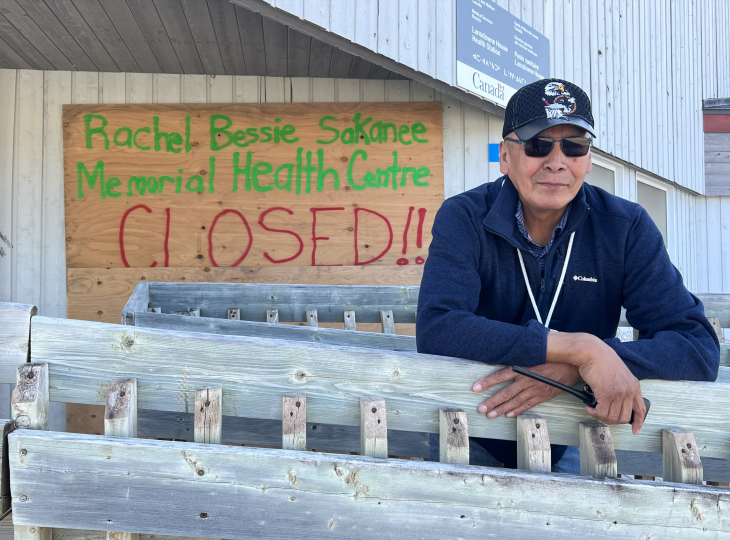
Kelvin Chicago wasn’t about to wait for the blockade into Lac Des Mille Lacs to lift before he found out if the forest fires had taken his home.
Knowing Ministry of Natural Resources staff would be blocking the road into the First Nation, where chief and council had declared a mandatory evacuation a week earlier, Chicago and his daughter put their boat into the water at the other end of the lake, and entered the community from the south.
First Nations people living on Lac Des Mille Lacs, 150 kilometers west of what is now Thunder Bay, were displaced by early hydro dam development nearby. Since 2006, they’ve been resettling in a community on this lake — among summer campers and outfitter’s lodges. Chicago built the first house on Lac Des Mille Lacs, years before the First Nation legally incorporated the area around it as a cottage lot development.
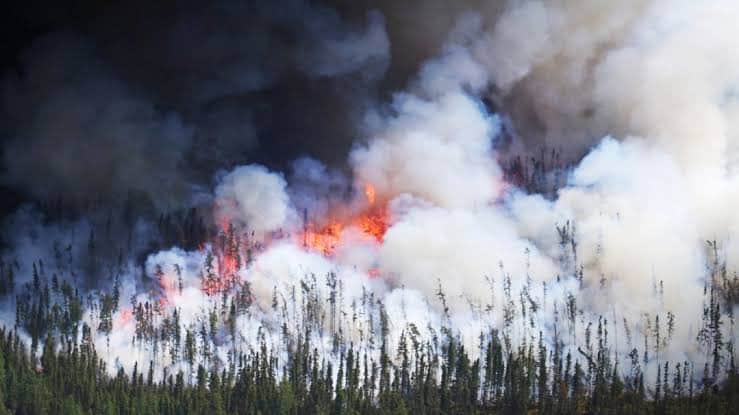
He knew the fire had torn through here. He’d even seen some of the photos lodge owners and firefighters had posted online. He prepared himself for the worst as he bounced over the waves across the lake.

“It was like travelling back, like the old days, before the road was in, to go home by boat. It was great,” Chicago said. “When we first hit Sand Point, I was expecting to see flames and burned out areas, but it wasn’t.”
Although the landscape wasn’t as charred as he’d expected, he landed on shore to find five homes had entirely burned down. A tired finger of brush fire had burned through the cemetery, but fell short of reaching the treeline.
“It was just horrible seeing the homes like that. There’s nothing there and the poor people, they struggle so hard to go home and then to lose it, you’ve got to see the pictures to believe it.”
He believes all the rest of the First Nation’s assets will be “recoverable.” He hosed down his home, made sure the fishing nets he’d stashed out on the land hadn’t been damaged, and made his way back out.
Chicago came out with peace of mind for himself, and an eyewitness account for his neighbours. But in doing so, he also became one of the very few people who are causing a very big headache for the MNR and the Ontario Provincial Police: those from mandatorily evacuated communities who either refuse to leave or are blowing blockades to get back into northern towns and First Nations that remain threatened by fire.
“For the most part, the communities have been unbelievably cooperative,” says Theresa Wabason, an OPP sergeant and a member of Whitesand First Nation, which is among the communities that have been evacuated northeast of Thunder Bay.
Wabason says those who are circumventing blockades are in the extreme minority.
He knew the fire had torn through here. He’d even seen some of the photos lodge owners and firefighters had posted online. He prepared himself for the worst as he bounced over the waves across the lake.
“They respect the road signs and chief and council, they intend to respect the evacuation orders and the road closures. They understand the importance is not to keep people away from their homes for no reason, it’s to give the MNR room to do what they need to do, to do fire suppression, to assist protection.”
But that’s not stopping everyone. One Armstrong resident posted a video to social media he claims shows a man breaking and entering while the town sits empty. MNR has a system to grant paper passes at blockades but authorities suspect some people are taking back roads, while a couple of drivers have been fined for running the blockades.
And in the case of Gull Bay, tension is mounting as Ontario’s largest-ever fire looms, while a number of members are still refusing to leave.
Elders left behind
Leaders of Armstrong, Whitesand First Nation and Kiashke Zaaging Anishinaabek (Gull Bay First Nation) declared mandatory evacuations on July 13, after nearby Namaygoosisagagun (Collins First Nation) burned to the ground, and its members fled in boats.
On the evening of July 20, MNR turned Gull Bay’s Hubert Wigwas back on the highway, as the band councillor attempted to bring supplies and medicines back to a small group of elders who were defying the evacuation order.
Then a minute after midnight on July 21, MNR formalized their Highway 527 blockade cutting access to Gull Bay, Armstrong and Whitesand.

“I explained to OPP that I need to go back over there because I’m an elected official,” Wigwas said. “And I knew that Wilfred [Chief Wilfred King] wasn’t going to let me back in because he’s got this thing where when he believes in something, he’s going to stick to it.”
Fifty-eight-year Wigwas crossed the line to go home. OPP found him in Gull Bay three days later, fining him $880 for unlawfully contravening an implementation order as well as $110 and three demerit points for driving on a closed highway.
Police have not charged or fined any of the elders Wigwas claims remain behind in KZA. He says those elders don’t feel confident in the plan for what will happen to them if they make the 215-kilometre drive to Thunder Bay, where cots are set up in hockey arenas because evacuees are filling local hotels.
“I’ve got five boats down the hill from my house,” he says. “If an emergency were to come, I would take them across the lake and they’re counting on me. They visited me today, hoping that I’m still here and they [the police] didn’t take me in.”


On Wednesday, King issued a release entitled “Please Evacuate,” which includes, in bold: “We ask that you please evacuate the reserve now. This is the most important thing you can do to keep yourself and our community safe.”
“I would not ask you to leave your home or our land if it were not truly necessary,” King wrote, listing provincial fines of $50,000 and up to a year imprisonment as consequences for remaining. “But for your own safety and for the safety of our community and our responders, please leave now.”
King’s letter follows a week of public communications in which Gull Bay’s chief and council have coaxed those remaining to leave, at times condemning members by name for sharing what they called political posturing or misinformation about the threat.
The southern tip of Thunder Bay 36, the name for Ontario’s largest-ever recorded fire that has been mapped at 313, 930 hectares, is about 27 kilometres north of Gull Bay. MNR teams are building berms along thin lakes to Gull Bay’s northwest, hoping to slow it down and dodge the fate of neighbouring Collins and Whitewater First Nations.
Beyond the leviathan fire to the north, King worries the Dryden 34 fire, the Thunder Bay 54 fire and the Dryden 35 fire west of Gull Bay could grow together into a blaze that would exceed 71,000 hectares. If the wind shifts, King said he fears their combined strength could burn from the west, overcome old growth forests in Obanga-Ottertooth Provincial Park, and rip straight through his community.
In an interview, King said he’s afraid his members are going to get caught in between two colossal and unpredictable fires versus the unforgiving winds and waves they’d face trying to escape in an outboard boat across Lake Nipigon.
“Our position has been, along with Whitesand First Nation chief and council, that nobody should be in our communities,” King said.
King said he’s afraid his members are going to get caught in between two colossal and unpredictable fires versus the unforgiving winds and waves they’d face trying to escape.
“First of all, if there’s anybody in the communities, MNR will not use water bombers to suppress the fire. If people are lingering in the community and they drop the water, it could seriously injure someone or kill them. It’s public safety – the safety of our members.
Secondly, we’re concerned about the real lack of police protection [against] looters or anybody who may try to do something nefarious in the community.”
As of Thursday, Wigwas was attempting to reach OPP, MNR, and band leadership, hoping to get some kind of guarantees for the safety of those he claims are depending on him.
“When the chief comes here and gives me hotel keys and meal tickets, I’ll leave,” he said. “I don’t want to run around over there, come back, and get charged again.”
Jon Thompson is a Local Journalism Initiative reporter based in Thunder Bay. Contact him with tips and story ideas at Jon@ricochet.media.