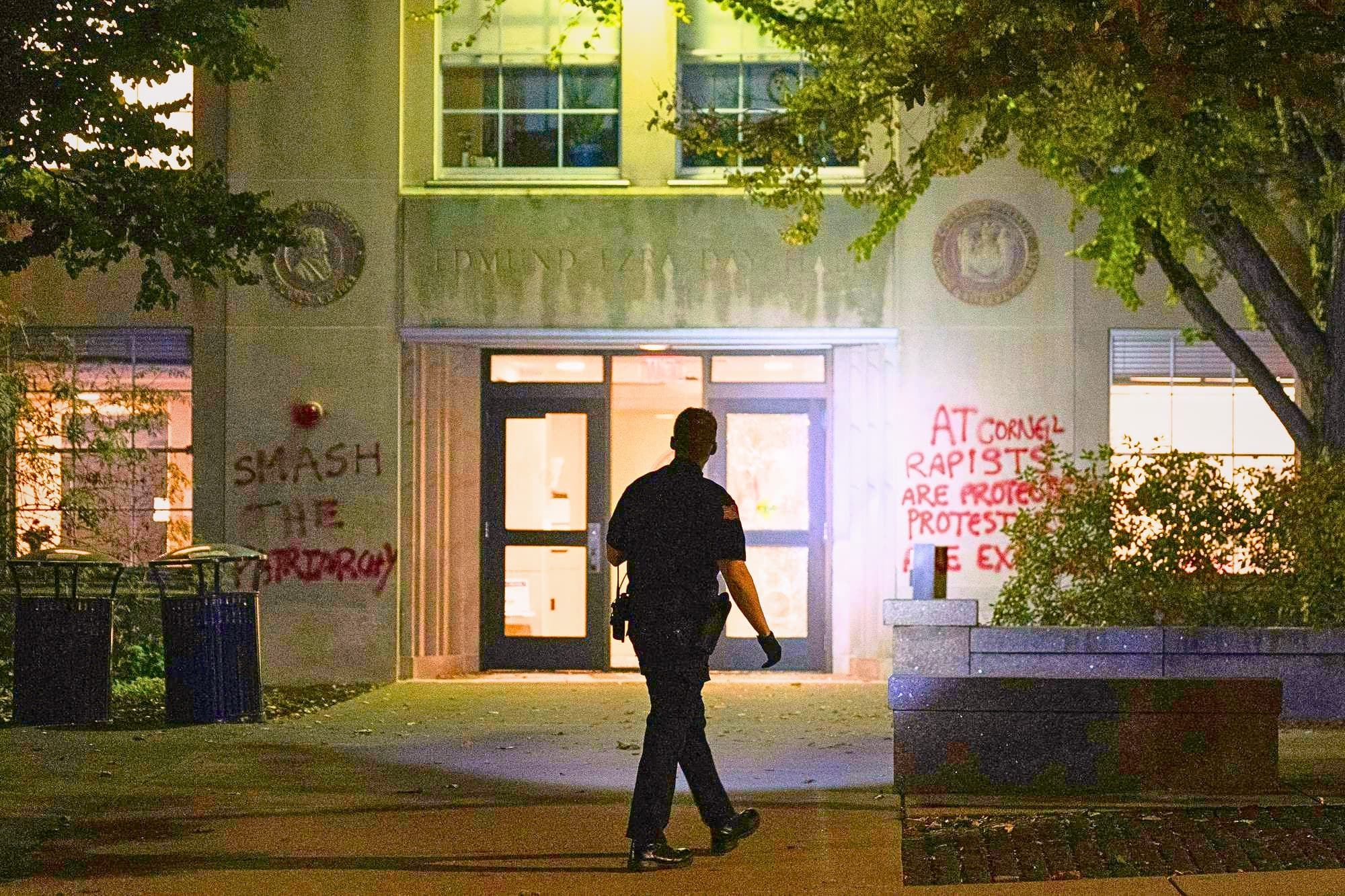

When I first heard about the “Cornell 7,” I was waiting in line at my university’s café, scrolling on Instagram. I didn’t feel shocked. In fact I felt almost nothing at all. The world continued to bustle around me — students picked out their lunches from the fridge behind me while my eyes stayed glued to my screen.
Seven men. Gang rape. Assault. Victim.
For a moment, this was just another story that many of us know more intimately than we’d like to admit — or than we’re allowed to admit. I didn’t need to know the details to understand what the story was about. My body knew before my mind.
My shoulders recoiled when I looked up and realized that I was in public, likely in the presence of other men who have sexually abused someone, or at the very least, considered it. (a 2019 review of studies found that, on average, 29 per cent of college men in the U.S. and Canada reported some form of sexual perpetration.)
When I arrived home I searched for the keywords to read the story for myself. It went as I suspected: according to a civil lawsuit, Matthew Ingalls, Johnathan Newell, Winston Lee, Gillio Lopes, Diego Sarabia, Scott Norris and Scott Kretzschmar of the Chi Phi fraternity at Cornell University, allegedly gang raped a 20 year-old college student known as Jane Doe in 2024. The men sent invitations to each other in a group Snapchat to have sex with Jane, leaving dehumanizing comments like, “shop still open?” and “free pussy upstairs.”
Jane Doe’s story is one among thousands just like it. Last year, Canada was gripped by the Hockey Canada sexual assault case, where a woman known as E.M. reported that junior hockey players gang raped her after sharing group texts that she was available for sex. E.M. said that while she was being assaulted, the men degraded, slapped, spat on, and insulted her. Too much of the public response was to blame E.M. and prop up Canada’s precious young, white, affluent hockey players, ignoring the connections between rape and class exploitation.
Why did the frat brothers and hockey players only see Jane Doe and E.M. as “free pussy,” reducing their entire beings to nothing more than an object to be exploited for sex? Why does capitalist society seem to breed generations of men who act incapable of empathy and lack the desire or courage to stand up to other men who commit such atrocities?
Institutions of power and coercion
Let’s start with what we know. Rape and violent misogyny happen across many societies, especially ones that are organized through hierarchy. Gang rape in the context of an institution like a fraternity or sports league is a particular kind of violence where the perpetrators act together for mutual benefit—an act that is about more than physical or sexual gratification.
To understand why, it helps to interrogate the purpose of these institutions. Elite sport is big business. It’s built on brand deals, public subsidies, and the labour of young players. Fraternities collect dues and own property, but what they really sell is access. Both kinds of institutions encourage treating the world as something to be conquered and accumulated. They produce competitiveness (as shown in this article about fraternities and this journal article about women abuse in hockey) and a shared worldview that some men are entitled to power and access.
At its most violent, that entitlement extends to women’s bodies and takes the form of group sexual assault. These kinds of assaults have been studied for decades. In 1991, psychologist Chris O’Sullivan looked at 24 documented gang rapes on U.S. college campuses and found that 22 of them were committed by fraternity members or college athletes. When the anthropologist Peggy Reeves Sanday studied fraternity gang rape in the 1980s, she found that the violence worked as a ritual of brotherhood, binding men through shared secrecy, risk, and loyalty. The woman becomes an object through which men prove themselves to one another. The act of rape becomes a kind of currency, reinforcing the perpetrators’ place in the brotherhood.

When considering how common violent misogyny is, we should also understand that dehumanization and objectification happens within these institutions against their own members. As a part of that objectification, frat brothers and athletes become commodities used to increase wealth, social status and power for the institution. For example, professional hockey players are scrutinized on how optimized their bodies are. Once they make the league, AI-powered sensors in their jerseys track their speed and movements, turning their bodies into data so their abilities can be monetized. Even as teenagers, hockey players’ labour is exploited, like we saw when junior hockey players settled a $30 million lawsuit over backpay for minimum wage.
The logic is a little different for fraternities where members join a “brotherhood” for chosen university students to “enhance their professional development” through power, access and wealth. In practice, this tribalism is upheld through psychological manipulation tactics like hazing that often include sexual violence used against each other. This abuse is widespread in both fraternities and sports leagues, even among children. Earlier this year for example, two 14-year-old boys on a minor hockey team in Nova Scotia were charged with sexually assaulting three of their teammates in an act of “hazing,” and one of them has since pleaded guilty. And a teen in Manitoba has been suspended, possibly banned for life, for psychological, physical and sexual abuse of his hockey teammates.
While men objectify each other and are simultaneously objectified by the institutions that take ownership over them, they then turn that control toward women. As one student columnist put it in 2018, sex acts in fraternities are viewed as a currency and women are “no more than something to be traded in return for entry” into the exclusive groups and parties. In hockey, one of the most disturbing examples of this objectification was the Junior Hockey League Bible, a Canadian guidebook posted on an anonymous blog (since scrubbed from the internet) created by young hockey players to instruct others on how to beat and rape women, record it, and get away with it. This kind of violence even happens in Canadian high schools. We saw this in Alberta when boys made a list of students they wanted to rape and torture.
With this continual detachment from one’s own humanity — while sexual violence and rape culture is encouraged and normalized — it’s no wonder that consent becomes essentially meaningless to some men.
What really is consent?
Legally speaking, for a sexual assault to occur in New York, where Cornell University is located, the law requires a clear refusal of sex or the victim to be physically helpless or “mentally incapacitated due to being drugged without their consent,” according to the Canadian Press. Under Canada’s Criminal Code, consent has to be voluntary and given for each specific act, and it can be withdrawn at any time. The Supreme Court of Canada has ruled that there is no such thing as implied consent, and that a person can’t consent while unconscious. But oftentimes in both the United States and Canada, the legal threshold for consent does not match what happens in reality, especially within institutionalized power. This is not an accident. Rape laws were not written to protect women, but were created to protect “property,” because women were considered “male property.”
Some people still have difficulty understanding that women have agency over their own bodies at every moment and may decide to have sex with one or multiple men, but this does not mean that they are automatically available for sex for others. In 2015, it was reported that only one in three Canadians know what consent is. Well, for those that don’t know: consent can be revoked at any time for any reason. A woman may consent to sex with one person, but then part-way through decide she no longer wants to. If her desire to end sex is not respected, this is when sex turns into assault and rape.

On September 28, a District Attorney in New York released a press release to explain why it did not originally pursue criminal charges against the Cornell fraternity members. It states “there is no evidence in Jane Doe’s statement indicating that she clearly expressed that she did not consent to the act.” But the release includes a statement from Jane Doe, detailing the events that she could remember after consuming large amounts of ketamine offered to her by the men. Jane reported that she consented to group sex with two men at the beginning of the night, but then was coerced by more men who arrived after being invited in the group Snapchat. The men continued to engage in sex with Jane, despite her saying “hell no,” slapping one of the men’s hands away, backing away from kissing, and hiding her naked body under the blanket. For those who are unaware: these are all signals that someone is not consenting to sex, whether the law reflects this or not.
In the Hockey Canada sexual assault case, hockey players Carter Hart, Alex Formenton, Cal Foote, Dillon Dubé and Michael McLeod were accused of gang raping E.M. Although the men were found not guilty in Canadian courts, E.M. maintains that she did not consent to sex with all of the men and I believe her.
On the night that E.M. said the rape occured, she consensually went into a room with one of the men to have sex. But soon, more men showed up while she was still naked and began to engage in sexual activity with her. She was surrounded by multiple naked men, groping at her and physically assaulting her. No one stopped for explicit consent. As E.M. describes it, the men’s desire for sex and domination was stronger than their empathy and care for her as a human. The assault continued until part way through, they pressured E.M. to record consent videos to say she was “okay” with what was going on. (The case was covered in detail by the Canadian True Crime Podcast, which I highly recommend to get a full picture of the nuances of this case.)
In the case of the so-called Cornell 7, Jane Doe sent a text to one of the men after the alleged assault. Much like E.M., Jane did not act like a perfect victim. She did not act angry or accusatory.
Society expects a perfect victim, but this will never exist. It doesn’t really matter how the victim of sexual abuse responds, they are too often vilified for the crime committed against them. In the Hockey Canada trial, the judge pointed to the consent videos, noting that E.M. was smiling, speaking normally and didn’t appear distressed. She used that to reject the Crown’s argument that E.M. stayed in the room out of fear.
E.M. was judged not on what happened to her, but on whether she acted like a victim while it was happening.
Race and class are also factors in how women are judged. Chrystul Kizer, a Black teenager, killed the white man who sex trafficked her as a teenager and she ended up in prison, though she argued it was self-defense. In Canada in 2015, a woman, found unconscious and half-naked, was raped in the backseat of a taxi while she was incapacitated, but a judge acquitted the taxi driver after he concluded that “a drunk can consent.” In Calgary in 2014, a judge asked a sexual assault survivor who was unhoused why she “didn’t just keep her knees together,” blaming the victim for not stopping her attacker. In Montana, a 14 year-old girl was raped by a teacher 35 years older than her. She was bullied relentlessly and the judge on the case partially blamed her for her own rape, saying she was in just as much control of the situation as her rapist because it wasn’t a “forcible beat-up rape.” She died by suicide.
It doesn’t matter if a woman screams, tries to laugh it off, plays along, cries, smiles, says stop, or fawns in order to stay alive, the outcome is the same. The woman is vilified by society, the media, law enforcement and the courts for being the victim of a crime of dehumanization, violence and misogyny. And justice rarely comes.

Like in E.M.’s testimony in the Hockey Canada sexual assault case, the Cornell 7 allegedly treated Jane Doe like an object to be exploited, not like a human.
Though the case of the “Cornell 7” was not shocking to me, I found myself in tears as I neared the end of Jane Doe’s initial statement provided in the District Attorney press release. During the consensual group sex at the beginning of the night, Jane said one of the men seemed unwell and another one started to feel sick, likely from the drugs they had consumed. Jane, who was also intoxicated, immediately stopped the situation to care for the men. Jane did what women have been conditioned to do: caretake for those around us. She said she was “patting his back” while also waking the other man “every few minutes to make sure he was okay.” She consoled one of the men, who then took that opportunity to reach for her vagina, but she “swatted his hand away.” That is when the third man entered and the alleged sexual assault began.
She cared for the men and then, she says, they raped her.
The institutions have always known that this systemic violence happens behind their closed doors. Hockey Canada even had a special fund built partly from registration fees and used it to pay out sexual assault claims, which is how they settled E.M.’s original lawsuit in 2022.
As this case gains international attention, some are saying it’s sparking the next #MeToo movement. But too often when these discussions are popularized in the media and within the institutions that breed these cultural norms, the true root causes of inequality is sanitized so the institutions can protect themselves.
We can’t allow our understanding of rape and sexual assaults to be divorced from how class exploitation perpetuates the objectification of women. We should continue to look for the patterns, the economic and social conditions that led us here, while recognizing that the laws we have were never meant to protect us as human beings. They were meant to protect property.
It’s past time that men recognize women are not property.