The pattern is constant. Doug Ford does something abhorrent. People push back. Then, during the aftershock, the pundits and the uncles and the coworkers and the strangers all line up to remind us that Ontario chose Doug Ford.
It comes out flat, almost bored: well, Ontario keeps voting him in. The inevitability of Doug is a real conversation killer.
It’s also wrong.
It is wrong arithmetically. It is wrong as a description of consent. It is wrong as a story about who Ontarians are and what they want. And it is doing political work — laundering a manufactured outcome into a popular mandate, telling exhausted nurses and teachers and tenants and disabled people that their own neighbours are the obstacle, and giving the Premier a permission slip for whatever he privatizes next.
From the maximum political donation changes to the low voter turnout, from weaponizing the notwithstanding clause to gutting the FOI law for personal benefit — Ford’s Conservatives have weakened our democracy again and again. In that context, “Ontario likes him” stops being an observation and starts being a distraction. A strategy. One we can name.
And one we can out-organize, right in our own neighbourhoods.
The math isn’t mathing
Most Ontarians did not vote for Doug Ford. That is a simple fact.
In 2022, his Progressive Conservatives won what every commentator called a sweeping majority — 83 of 124 seats, or about 67 per cent of the legislature, on roughly 40.8 per cent of the vote. The turnout was 43.5 per cent, the lowest in Ontario’s history at the time.
Run the multiplication. Forty per cent of 44 per cent is about 18 per cent. Fewer than one in five eligible voters in Ontario marked a ballot for Doug Ford’s party. The other four out of five voted for someone else, spoiled a ballot, or stayed home.
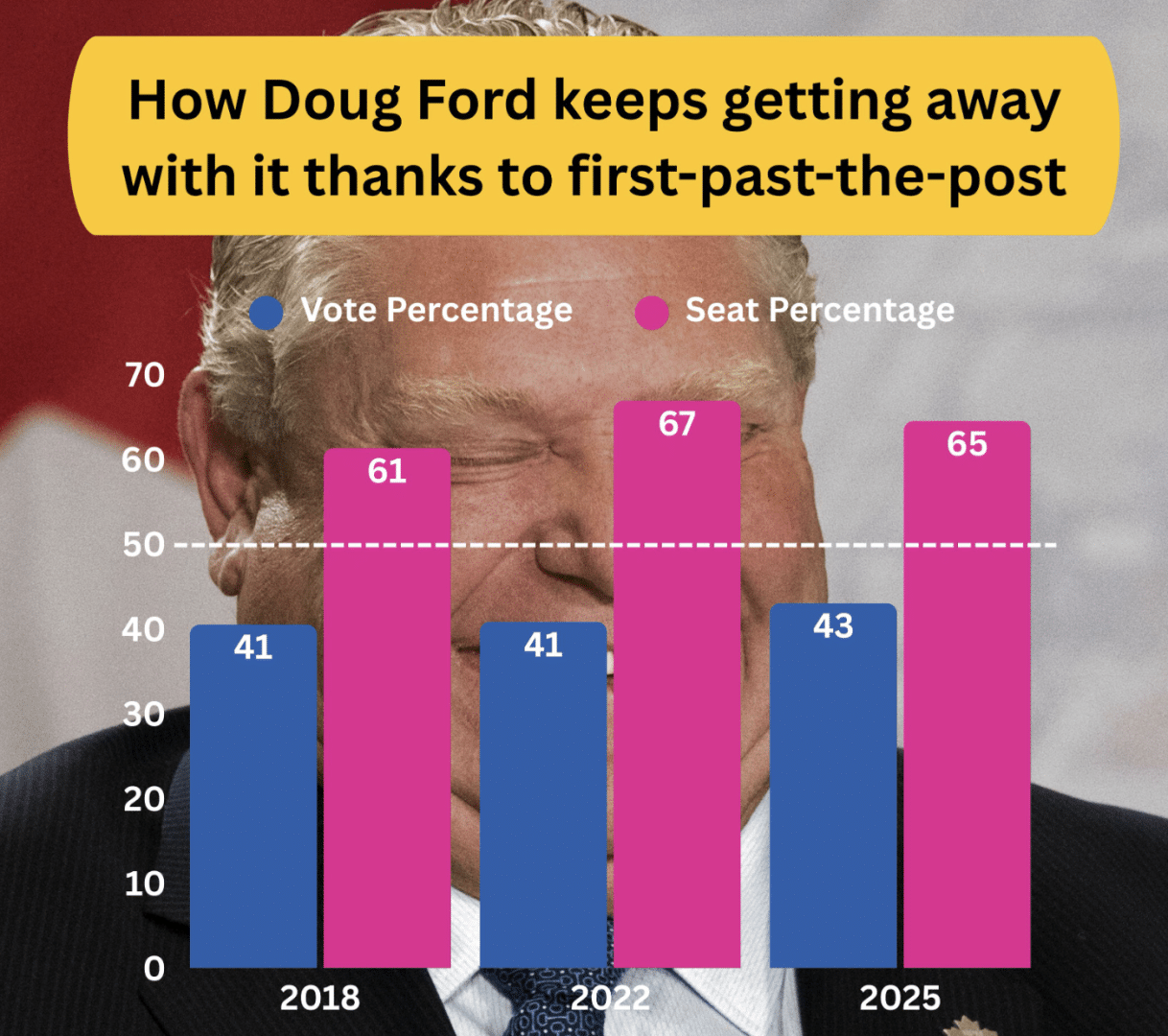
In 2025, the PCs improved their vote share to about 43 per cent, lost three seats, and held a slightly higher 45 per cent turnout, according to the CBC’s 2025 results. The math barely moved. Roughly one in five Ontarians, again, signed off on the program. The rest did not.
When a result like that gets translated into “Ontario chose him,” a specific sleight-of-hand is happening. The system converts a minority of a minority into a majority of seats, and then the language converts a majority of seats back into “the people.” That is not a description of democracy. This is a carnival trick.
The overwhelming narrative blames voters for not turning out and opposition parties for not showing up. That’s the easy story. The truth is more complicated.
Whenever Ford’s power looks like it might be threatened, he changes the rules of the game. It’s short-term, it’s frankly childish, and he won’t be Premier forever — but he’s laid the groundwork for whoever governs next to play on his rigged board.
Following the money
Let’s go back to 2021, when Ford’s popularity was waning and an election was on the horizon. He moved the goalposts so that his party could raise more money with less effort.
I’m talking about Bill 307, passed in 2021 and titled, with the kind of straight face only a Queen’s Park communications team can muster, the Protecting Elections and Defending Democracy Act. When the courts struck down parts of it as a violation of Charter rights, the government invoked the notwithstanding clause to push it through anyway — the first time in Ontario’s history a government had used that tool, and it was used to override a court protecting free expression in elections.
What Bill 307 actually did:
- Doubled the maximum individual political donation from $1,625 to $3,325, and made it stackable across the party, the riding association, and the candidate.
- Doubled the third-party advertising restriction period from six months to one year, while leaving the spending cap at $600,000 — meaning unions, nurses’ associations, teachers, and any other organization that might want to publicly disagree with the government were forced to spread the same money over twice the timeframe.
- Maintained, then leaned on, tax-funded rebates for wealthy donors, effectively having the public subsidize the donor class’s political influence.
In the aftermath of the 2022 election I analyzed the impacts of this policy and quantified just how much it helped the PCs — who historically have a wealthier donor base — over the other parties. Four years later, more receipts are in.
Elections Ontario donations analysis, 2021–present
| Party | Total raised | From above old threshold | Above-threshold donors | % of total from above-threshold money |
|---|---|---|---|---|
| PC | $69.4M | $31.3M | 7,757 | 45.2% |
| OLP | $22.2M | $8.2M | 1,994 | 36.8% |
| ONDP | $19.9M | $4.0M | 900 | 20.4% |
| Green | $7.4M | $1.3M | 304 | 18.2% |
The PCs are not just raising more total money. They are raising a structurally different kind of money — concentrated, large-cheque, donor-class money. The NDP’s small-cheque profile (only one in five dollars from above-threshold donors) is the inverse pattern. The change in the maximum, made stackable across the party, the leader, and riding candidates, creates a system where the wealthiest donor class can pour tens of thousands of dollars into keeping the party that serves their interests in power. This is not a difference of support. It is a difference of wealth.
Take Will Bouma. He’s a sitting PC MPP and Parliamentary Assistant to the Premier himself. He donated the legal maximum to his own party. So did his wife. That’s $66,650 from one household into the party Bouma directly serves — every dollar of it only legal because his government doubled the cap.
Not illegal. Just absurd. An MPP recycling their public salary into their party’s political infrastructure, and getting a tax deduction on the way out. Our tax dollars are paying those same donors back a large portion of their financing.
And this doesn’t only benefit the PCs. Under the old $1,625 cap, the PCs would have raised $38M, the OLP $14M, the NDP $15.8M. The OLP would be behind the NDP in donor money. The doubled cap didn’t just rescue Ford — it specifically rescued and entrenched the OLP as the second financial bloc, displacing the NDP. The gap between the parties’ total contributors is under a thousand, but the OLP has twice as many people taking advantage of the new maximums.
This is structural class politics buried in the donation rules.
Stack the rest of the architecture on top:
- The notwithstanding clause, used pre-emptively in 2021 and threatened repeatedly since — including against education workers in 2022. A government that reaches for the override clause to deal with its own employees isn’t governing — it’s bullying.
- The freedom-of-information system, now functionally gutted by fee hikes, redactions, and delays that put basic records out of reach of journalists and watchdog groups.
- Municipal restructuring — strong-mayor powers now extended to 169 additional municipalities as of 2025, on top of ward redraws and the Greenbelt swap. Each of these moves power upward and away from the levels of government where opposition has historically been most effective.
None of these are individually disqualifying. Cumulatively, they are the rulebook of the game. And the rulebook was written by one of the players.

Who is actually paying for this
The companion question to “who is voting for Ford” is “who is paying for Ford,” and that one has a much more honest answer.
The 7,757 people now donating above the old ceiling to the PCs are, by definition, not the median Ontarian. They are people with the cash to write a $3,325 cheque, multiplied across party, riding, and candidate, every year. The NDP, by contrast, raises its money on an average donation of $29 from tens of thousands of small donors — a fundraising profile that looks like a coalition rather than a transfer mechanism.
What that donor class is buying is well documented. We covered Will Bouma above, but he’s hardly exceptional for donating in his own interests. A few more names from the Elections Ontario contribution records:
- Peter Saad — $35,960. Managing Partner of Loopstra Nixon LLP, a Toronto law firm. Loopstra Nixon is publicly described by Chambers Canada as “well connected and experienced in dealing with zoning and land use approvals in the province of Ontario.” The firm’s own municipal, land use, planning, and development law practice is built around Ontario Land Tribunal appearances, MZO files, and developer-side land planning — exactly the kind of work the Ford government has been handing out like candy. Saad himself specializes in corporate healthcare-sector mergers and acquisitions, and pharmacy-consolidator advisory, which lines up neatly with the Ford government’s healthcare privatization push. Peter Saad isn’t writing cheques out of civic enthusiasm. His firm’s bread and butter is exactly what this government keeps offering.
- And it’s a family hobby. Four Saads sit in the top eleven max donors — Peter, Marian, Soufy, and Angelos — for a combined $121,970 in a single year. One household. Four maxed-out cheques. That is the mechanism the doubled cap was built for.
- Carlo Fidani — $33,398. Chairman of Orlando Corporation, Mississauga-based, one of Canada’s largest commercial real estate developers — managing roughly 44 million square feet of commercial, industrial, and office space. Inherited the firm from his father. A textbook donor-class profile: a third-generation industrial real estate empire writing the legal maximum to the party that issues MZOs and shapes Ontario’s industrial land policy.
- Isai Scheinberg — $26,120. The founder of PokerStars. Pleaded guilty in 2020 in the U.S. Southern District of New York to running an illegal gambling business. Avoided prison through a $30,000 fine and 26 days in a Swiss jail. In reporting for Ricochet, Cecil Rosner laid out the story in 2023. In April 2022, the Ford government launched legal iGaming in Ontario — the same kind of market Scheinberg got rich on illegally in the U.S. Now he writes maximum cheques to the government that opened the door.
This is the part of the story where the word “popularity” stops being useful. Ford is not popular with the donor class because the donor class likes his charm. He is popular with them because his government is, materially, a transfer mechanism. The puzzle of “why does he keep winning” stops being a puzzle the moment you stop treating the donor class and the electorate as the same group.
The real cost is paid by communities. Every shelter shuttered, every college program cancelled, every over-burdened municipality, every burnt-out nurse — all of it is the cost of Ford’s government.
How we lose
We know what doesn’t work.
Expecting the same institution that broke itself — provincial electoral politics — to fix itself on its own is naive at best. It is tempting, and wrong, to attribute Ford’s success purely to what he has built. The opposition parties have made choices too. They won’t save us.
The real cost is paid by communities. Every shelter shuttered, every college program cancelled, every over-burdened municipality, every burnt-out nurse — all of it is the cost of Ford’s government.
The Ontario Liberals, since 2018, have operated less like a political project and more like a brand reconsolidation. The strategic logic — pursue ridings where the Liberals can plausibly take a seat from the NDP, which has no impact on Ford’s majority seat count — is the logic of a firm protecting market share, not a coalition trying to beat a government. After its significant loss in 2018 the party has built itself from 7 seats to 14 seats. Three of those seats were won by unseating NDP ridings where the PCs were a distant third (Beaches East York, Kingston and The Islands, and Toronto St. Paul’s). It treats progressive votes as a resource to be captured rather than a coalition to be built, and it has produced, predictably, neither a Liberal government nor a defeat of Ford.
The Ontario NDP’s failure is different, and in some ways more painful. In 2018, they ran on a recognizably progressive program, came within striking distance, and formed the official opposition. The lesson available to them was that Ontarians, when offered a real alternative, will move toward it. The lesson they appear to have taken instead was to soften the program, broaden the tent toward a middle that does not actually exist as a stable bloc, and lose ground in 2022 and again in 2025. Twenty-seven seats on 18.5 per cent of the vote in 2025, down from 40 seats on 33.6 per cent in 2018, is not a recalibration. It is a retreat. One that the membership has openly dissented from — Marit Stiles only narrowly survived her leadership review.
So if the parties aren’t coming to save us, who is?
We save each other.

We win when we mobilize
Ford’s Conservatives know their biggest threat is when Ontarians mobilize. Which is why they’ve spent so much energy trying to burn us out.
The Ford government’s record, taken on its own terms, is a record of removing the capacity of the public to push back. Wage caps on nurses and educators under Bill 124. Sustained attacks on public-sector unions, including the pre-emptive notwithstanding-clause threat against CUPE’s education workers in 2022. The gutting of the college sector. The downloading of services and costs to municipalities that do not have the revenue tools to absorb them. The functional dismantling of the FOI system that watchdog journalism depends on.
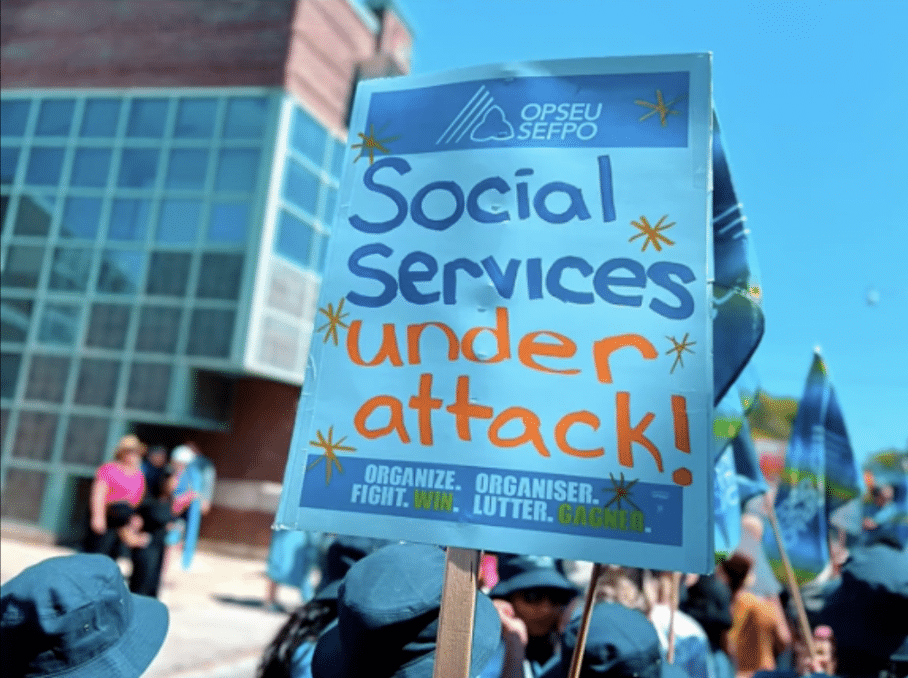
Each of these targets a group with the proven capacity to mobilize. Each one degrades that capacity. You do not need a grand theory of authoritarianism to see the pattern. You only need to ask, of every major policy change in seven years, which Ontarians does this make less able to organize next time.
The cost lands on the people who already had the least, and the political effect lands on everyone. When the nurse who would have knocked on doors is working a double, when the teacher who would have run as a candidate is navigating dismantled school boards, when the renter who would have voted is moving for the third time in two years, the electorate that was is not the electorate the next pollster will measure. It is the electorate the government has produced.
The line at the dinner table — Ontario keeps voting him in — is built to disguise this. It treats a deliberately weakened public as a baseline of public opinion. It is not.
The opportunity is already here
Building a united, resilient, mobilized province doesn’t have to wait for the next provincial election. The work starts now.
Ontario’s municipal elections are on October 26, 2026. Nominations opened on May 1 and close August 21. Every council position in every municipality across the province is up at the same time. This is the largest single democratic event between now and the next provincial campaign. And it is the level of government Ford has spent his entire premiership trying to weaken — through forced amalgamations, ward cuts, strong-mayor powers now extended to 169 additional municipalities, and the steady downloading of costs without revenue.
This isn’t theoretical. Zohran Mamdani’s coalition in New York brought in over 100,000 first-time voters by going to the people most parties had given up on
He has done this for a reason. Municipalities and school boards are where opposition to a provincial program actually lands — in zoning fights, in shelter funding, in transit decisions, in encampment responses, in school closures, in library hours, in the local health board’s response when the province defunds a service. A council willing to say no to the premier’s preferred contractor, or yes to a renter protection his government refuses to legislate, is a council that costs his coalition real money and real political space. Multiply that across 444 municipalities and it is a structural problem for him.
Our opportunities don’t stop there. They extend to every organization and program that comes into contact with the provincial government. Hospitals, shelters, community living centres, conservation authorities, and dozens of organizations we rely on day to day have governance structures with a direct relationship to the province.
Before you do anything, map your power. Everyone has some — but not everyone is empowered to use it, and that’s by design. What community groups do you belong to that could back a council candidate? What memberships do you hold? Does your job put you in rooms with Ford’s influential donors? Can you contribute to your local union’s strike fund? Can you opt out of the privatized services eating away at labour’s negotiating position? Do you know who is financing the donor pipeline — and can you make a conscious effort to divest from them, and tell them why?
Once you’ve mapped yours, here are some places to put it to work:
- If you can’t run, back someone who will. Council seats, school board trustee seats, and — in the municipalities that have them — police services board appointments. The nomination window is open right now. The barrier to entry is lower than it has ever been compared to provincial politics, and the leverage on Ford’s actual program is higher.
- Push for hospital board, nonprofit board, conservation authority, and trade board seats. These are governance structures Ford has spent seven years quietly capturing or starving. They are also, in most cases, open to community members who put their hand up. Even if you don’t run, you can become a voting member and attend an Annual General Meeting where the board is elected. Every one of them is a place where a community can hold ground the province is trying to take.
- Treat community infrastructure as political infrastructure. Tenant associations, mutual aid networks, food banks, neighbourhood associations, faith communities, parent councils, immigrant settlement networks. These are the bodies that hold people through the period of downloading and service cuts, and they are also the bodies that turn out neighbours when the time comes. Party politics, even the best case scenario ones, are not going to save us on their own. Community strength will — regardless of who is in office.
The reason to do all of this is not to wait for a better premier. It is to build a province that is, in the most concrete possible sense, harder to govern badly. Every council that pushes back. Every board that refuses a privatization deal. Every union that holds the line. Every neighbour who knows the name of their trustee. Every nominated candidate in a riding the PCs assumed they had locked. Each of these is a small redistribution of power back toward the people the architecture was designed to lock out.
This isn’t theoretical. Zohran Mamdani’s coalition in New York brought in over 100,000 first-time voters by going to the people most parties had given up on and offering them something worth showing up for. Lula’s coalition in Brazil defeated a far-right incumbent who had spent four years degrading the electoral system itself. Neither is a template. Both are proof it can be done.
The next time someone tells you Ontario chose this, the smallest possible correction is the math: roughly one in five eligible voters. The next smallest is the rulebook: a doubled donation cap that handed the governing party a $31 million structural advantage over four years, paid for in part by the public through donor tax rebates. The one after that is the municipal opportunity: October 26, register by August 21.
The line at the dinner table is not innocent. It feeds the apathy machine that makes Doug Ford feel inevitable. Don’t feed it.
The system did this. A community, doing the slow and unglamorous work of re-strengthening every place Doug Ford has spent seven years eroding, is what undoes it.