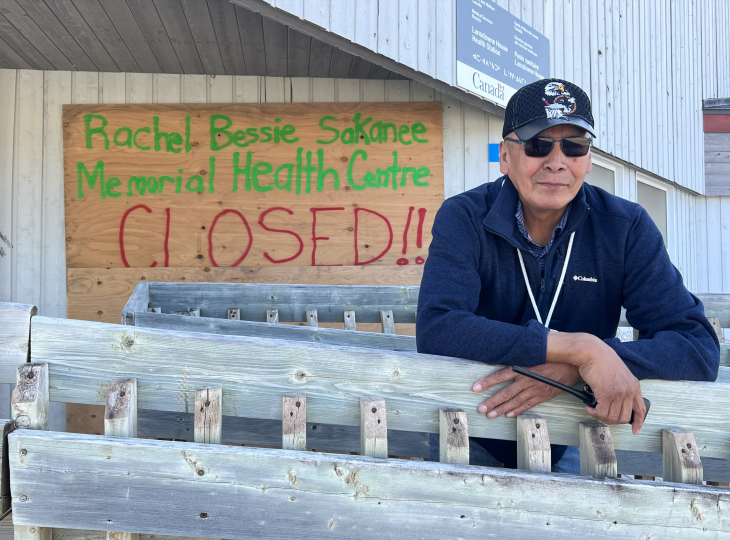
The plywood board nailed over the entrance to the Rachel Bessie Sakanee Memorial Health Centre in Neskantaga First Nation is spray-painted, “CLOSED.”
Five weeks after Neskantaga’s chief and council declared a state of emergency and evacuation, they shuttered the community’s nursing station permanently after soil tests revealed fuel in the groundwater under the building.
The diesel tank needed to power the facility had been replaced in November, but Chief Gary Quisess said these results show either a spill or a leakage has occurred and that they confirm the site has no long-term viability as a health centre.
“It’s on the opposite side of the building from the fuel tank, so it’s kind of puzzling,” he said. “Underground, the water table is high in some places. There’s a stream, an underground spring, under every hill.”

On April 13, the temperature jumped from below freezing to 12 degrees Celsius, thawing snow banks quickly and flooding the health centre for the third consecutive year. A thick smell of fuel surrounded the building for 25 metres in every direction, patients showed symptoms consistent with environmental contaminants, and experts worried that mold could be a factor.
Chief and council issued an evacuation order on April 14. Two-thirds of Neskantaga’s 300 on-reserve members have since been living 450 kilometres southwest, in Thunder Bay.
The few remaining in the community demonstrated outside the condemned building on Friday, demanding action to replace the health facility. Quisess said he told visiting Indigenous Services Canada on May 14 that if testing proved the site to be contaminated, Neskantaga would request that a new facility be built.
“Hopefully, we’ll be heard and it will put some action in so the work can get done early,” he said. “There’s going to be more testing. By next week, we’re going to have a report and a thorough investigation.”

A duplex has been converted into a temporary health station, using equipment nurses moved from the condemned site.
The first flight of evacuees returned home on May 18, with priority given to school-aged children. The school boiler that broke in early April and cost students 10 school days prior to the evacuation has now been fixed. Teachers have been holding classes in Thunder Bay hotel conference rooms to ensure they meet the mandated number of classroom days.
Quisess says every action is being taken so young people don’t bear the cost of this state of emergency. “It’s getting close to graduation date so they’ll have to work hard to get their year,” he said.

Their return comes as Ontario prepares for two days of committee discussions on May 22 and 26 over its proposed Bill 5, the Protect Ontario by Unleashing our Economy Act.
Among reductions of rigour in the environmental review processes, the Act would also allow for fast-tracked permit granting and development in “special economic zones.” Premier Doug Ford has said the first such designated zone would be in the proposed Ring of Fire, a 5,000-square-kilometre mineral deposit downriver from Neskantaga.
The community has ordered chief and council to take a firm position against Ring of Fire development without their consent. Members voiced opposition at Queen’s Park last week joining the chorus of First Nations condemning Bill 5 for what they say infringes on their rights to consultation and accommodation.
Quisess said between the school, the health centre, a 30-year boil-water advisory — the longest in the entire country — an opioid crisis, and poor roads, the link between the Crown failing to honour basic needs in local infrastructure and constitutional partnerships over major resource projects is clear to the community.
“First Nations are suffering right now with everything. All the federal and provincial infrastructure we’ve put in, we have nothing,” Quisess said. “I was given a culture and I respect my culture. There’s no price on a culture. We love our land, we love our resources. I don’t know how they’re going to deal with that.
“They’re going to have to deal with us, and with our culture.”
Jon Thompson is a Local Journalism Initiative Reporter based in Thunder Bay. Contact him with tips and story ideas at editor@ricochet.media.