I’ve been covering Indigenous rights and environmental protection stories for years, but yesterday’s court proceedings at the B.C. Supreme Court in Vancouver felt different — heavy with the weight of history and the urgency of what’s unfolding around our world, and in this case in the Upper Walbran Valley.
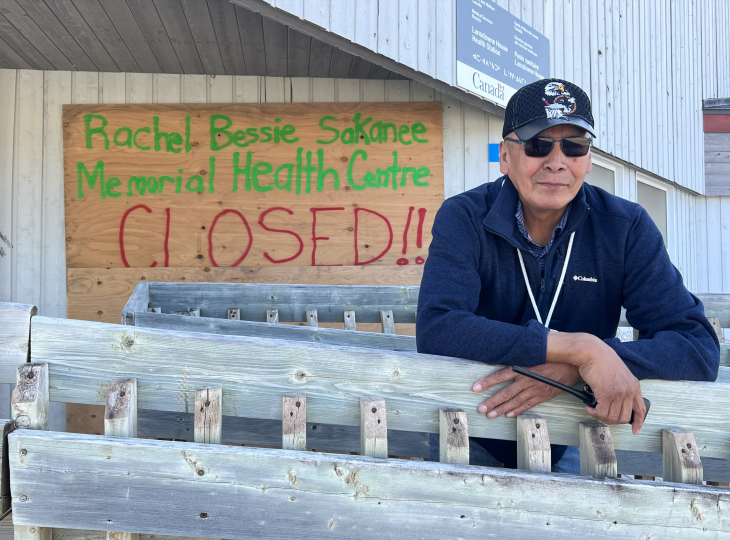
Elder Bill Jones has done something unprecedented. The silver haired 85-year-old Pacheedaht residential school survivor was at the heart of the largest act of civil disobedience in Canadian history four years ago. Now, his voice booming with conviction despite his slow pace, he’s going back on the offensive to protect some of the oldest trees in North America.
On September 9, he filed a federal court application for judicial review against his own Nation — the Pacheedaht First Nation — challenging the approval of new forestry activities in his traditional territory that he says happened without consulting him or other members, or giving them notice.
I was in court earlier this week as the B.C. Supreme Court heard arguments about whether to grant an injunction that would allow Western Forest Products and Huumiis Ventures to remove the forest protection camp (or blockade) that’s been hampering old-growth logging since August 25. Elder Jones was there too, having made the trek from his home on Vancouver Island. He’s named as a defendant in the emergency injunction application.
The judge didn’t issue the injunction, so the parties will be back in court Thursday morning for the resolution of what feels like a pivotal moment.

But Elder Jones’s federal lawsuit reveals the deeper colonial machinery at work here. According to court documents obtained by Ricochet, the Pacheedaht First Nation consented to roadbuilding and logging in the Upper Walbran Valley on June 2, 2025, without consulting Elder Jones — a band member under the Indian Act. He said he only learned about their agreement on September 4. This followed a pattern: the nation had already entered into a revenue sharing agreement with British Columbia on May 6, 2024, again without consulting him (or others).
Elder Jones is arguing through lawyer Ben Isitt that the Pacheedaht council “exercised its powers under the Indian Act unlawfully” and violated principles of natural justice and procedural fairness. He’s seeking a declaration that the council acted beyond its jurisdiction and an order setting aside their decision.
There’s a clause in the Province of B.C.’s resource revenue sharing agreement with the Pacheedaht First Nation that essentially muzzles opposition. It states that the “Pacheedaht First Nation agrees it will not support or participate in any acts that frustrate, delay, stop or otherwise physically impede or interfere with provincially authorized forest activities” and requires them to “promptly and fully cooperate with and provide its support to British Columbia in seeking to resolve any action that might be taken by a member of First Nation that is inconsistent with this Agreement.”
Isitt called this economic coercion — something he’d never seen before in such agreements. It’s a stark example of how the colonial system creates impossible positions for Indigenous nations, forcing them to choose between economic survival and the protection of their traditional territories.

Elder Jones, who survived the horrors of the Alberni Indian Residential School, sees this through a decolonial lens. He doesn’t view his Indian Act-elected band council as legitimate — he sees it as part of the enforcement system imposed by colonial Canada to control Indigenous peoples. He believes in the traditional hereditary governance system that the colonial government tried to wipe out, though even that system faces fragmentation and disputes within Pacheedaht.
Meanwhile, lawyers for the logging companies — officially named on court documents as Tsawak-Qin Forestry Limited Partnership and Tsawak-Qin Forestry Inc. — argued that the blockade is causing “irrevocable harm” to their business operations, citing the potential loss of eleven full-time jobs and claiming the “situation is spinning out of control again” like it did during the 2021 Fairy Creek protests, where over 1,100 people were arrested in what became Canada’s largest act of civil disobedience.
The companies’ lawyer insisted that the “protestors’ real complaint is with government policy,” since the companies’ hold legitimate logging licenses from the province.
Elder Jones says he is fighting for his Aboriginal and Charter rights, raising concerns about climate change and what he sees as the ecological rights of one of Vancouver Island’s last intact ancient forest watersheds.
As I prepare to drive out to the blockade, where I’ll be doing more reporting in the days to come, I’m struck by Elder Jones’s words to me after court: “I want her to see my soul, to see my whole self, my person. To show her that this world still has independence and we’re not all stuck in a system of being controlled.” He was referring to Justice Amy Francis, who will decide whether to grant the injunction on Thursday.
This isn’t just about trees, though the Upper Walbran contains some of the last unprotected ancient forests in British Columbia, teeming with irreplaceable ecosystems. This is about Indigenous sovereignty, the ongoing impacts of colonization, and whether our legal systems can recognize that some things — like thousand-year-old trees and the cultural and spiritual significance they hold — shouldn’t be reduced to economic calculations.
The Walbran Valley was ground zero for the “War in the Woods” protests of the 1980s and 1990s, which led to the protection of some areas but left gaps that activists are still fighting over today. Now, with the RCMP’s Critical Response Unit (the new name for the Community-Industry Response Group) potentially prepared to enforce any injunction that may be issued using tactics that have been criticized as excessive and intimidating, we may be about to witness another chapter in that ongoing war.
But Elder Jones’s federal lawsuit against his own nation adds a new dimension — a direct challenge to the colonial systems that force Indigenous communities into impossible positions. Whether the courts will recognize the legitimacy of his argument remains to be seen, but his courage in taking on both the logging industry and the colonial apparatus that enables it deserves public attention.
As I head into the forest to document what unfolds over the coming days, I’m reminded that this story extends far beyond courtrooms and legal procedures. It’s about land defenders from all walks of life putting everything on the line because they believe some things are worth more than profit. It’s about an 85-year-old residential school survivor who refuses to be silenced by systems designed to control him.
The trees have stood for a thousand years. The question is whether our institutions have the wisdom to let them stand for a thousand more.