Roy Cutfeet’s pager flickered an address into the dark. It was the middle of the night, in the middle of the winter in his fly-in hometown of Kitchenuhmaykoosib Inninuwug First Nation, and he was the only volunteer on duty to drive the vehicle they called an “ambulance.”
He arrived on the scene to find a woman without a pulse.
“I was caught in a puzzle,” he recalls. “I had to ask the daughter to drive so I could do CPR on her mom in the back, who died on the way to the clinic. Since then, nobody ever reached out to me to see if I needed debriefing. These are issues that happen. They just throw you on a bus with no support.”
Years later, Cutfeet serves as the health director for the First Nation of 1,500 people on Big Trout Lake. While there have been some changes, he describes the state of emergency response in KI the same way.
KI has ambulances but they’re unusable. The unresolved trauma and lack of support that Cutfeet experienced has eroded the volunteer base and now there’s no one left. The last funded training with provincial staff who flew 450 kilometres from Kenora took place in 2022. Especially through the evenings and on weekends when health emergencies are likely to be more severe, the top executive is taking almost all after-hours calls himself.
“If I put word out today, I can honestly say no one would go,” Cutfeet says. “We’ve tried it. We’ve offered employment at $150 just to drive. We still can’t find a driver. That’s because they know what else comes with that. They know medivacs are included. They know they’ll see things they don’t want to see.”

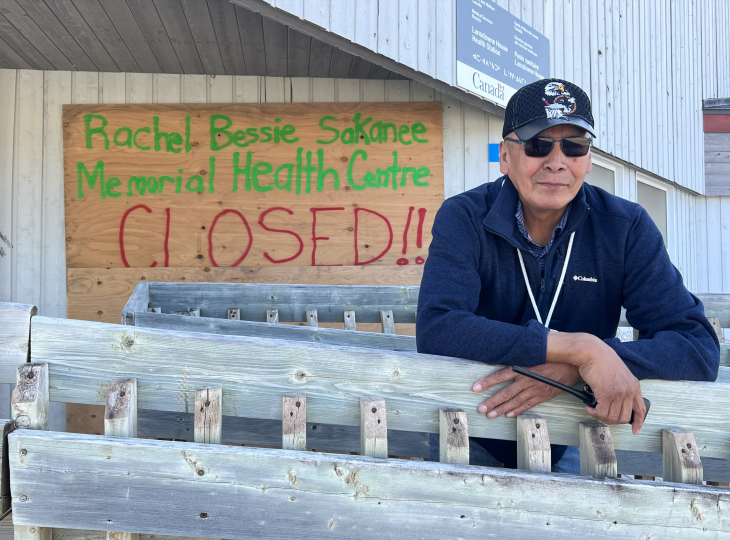
When Jacob McKay started driving medical transport in 1996, he received $10 per transfer. Thirty years later, he still takes most of the emergent ambulance calls during the day, he just doesn’t get paid for that. McKay’s office, where he manages the elder’s lodge, is in the Saggius Sainnawap Memorial Health Centre, where the transport vehicles are parked outside. It’s closer than Cutfeet’s desk at the band office, two kilometres away. McKay says the vehicles are even fitted with some new equipment such as defibrillators (AEDs), which might have changed the outcome for the case that traumatized Cutfeet all those years ago – but no one is trained to use any of it.
“It’s load and go. We’re not certified to do bandaging or anything. We just toss them in the ambulance,” McKay says. “It deters other people from joining the emergency services, the lack of training. They don’t even know how to operate a stretcher. They don’t know how to use the levers.”
“It’s load and go. We’re not certified to do bandaging or anything. We just toss them in the ambulance.”
Cutfeet and McKay’s department has had an ambulance for six years. It’s funded and stocked, but a traffic collision at the rear caused the right back door to peel open from the bottom. The paramedics that fly in from Thunder Bay (600 kilometres south) or Sault Ste. Marie (over 1,000 kilometres) refuse to use it, considering it unsafe work to have a patient present while snow or dust is blowing into the aft of the vehicle. Instead, they use a 15-seater van or an old, modified handi-transit bus.
There was a moment of excitement in KI when a newer ambulance arrived this year. Cutfeet’s second-cousin Shane Cutfeet, who is the assistant medical director, received the call in March. A used ambulance was arriving by ice road that day, and could he meet them halfway to pick it up? He drove out to sign for it, but Ontario didn’t connect the vehicle to any training or even any funding to operate it. The community also doesn’t have an indoor space to store it as autumn sets in.

Shane Cutfeet also drives these vehicles in emergencies, although they disrupt his job of administrating home and community care programs. He says he can’t squeeze any more money out of programming to operate the ambulance, when his $300,000 homecare budget would be right-sized at $1.2 to $1.5 million.
“I fought for more funding. It was $10,000. I had to walk out of that teleconference,” he explains. “They might as well have offered to throw peanuts at my face.”
KI Chief Donny Morris calls the state of EMS “ridiculous,” pointing out that operating funds come with infrastructure in cities of comparable size and that no municipally-elected leaders or bureaucrats in Ontario have comparable frontline responsibilities.
“We’ve had so many people die after going to the clinic and not knowing the extent of the issue.”
“The mayor and health directors, they don’t go to a crisis, because they have a payroll of professionals that are trained to help out,” Morris says. “But in the community, it’s a health director, assistant, chief, council or somebody because we just don’t have the human resources for them to do that work, especially after hours.”
The issue reached a boiling point this summer when a local trend of drinking body spray as an alcohol substitute emerged among young people. Sixteen KI youths have been flown out to hospital with symptoms of poisoning. Two 14-year-old girls died, unable to reach care in time.
Those deaths prompted Morris and his council to declare a state of emergency on July 31. Ontario allegedly didn’t respond, nor did the minister respond to Ricochet Media’s requests for comment. So along with the Independent First Nations Alliance, KI filed a human rights complaint against the province in early September, claiming the Ministry of Health, “has persistently failed to provide adequate funding and resources, forcing these communities to have inadequate – or completely absent – EMS.”

Morris feels driven to bringing attention to the cause through whatever actions he can. At last week’s Assembly of First Nations meetings in Winnipeg, he called on the Deputy Minister of Crown-Indigenous Relations and Northern Affairs to visit fly-in First Nations in northern Ontario to see each of their unique needs.
“Don’t assume. You’re sitting in Ottawa, ‘Oh, Big Trout has this,’ and they think, ‘Oh, Bearskin probably has that, probably has the same things.’ They don’t. I expect Valerie Gideon to visit our community.”
A statement from the ministry says Gideon changed roles in November 2023 and is, “no longer involved with paramedical resources; therefore, she does not have plans to travel to the community, although has done so in the past.”
“I had to ask the daughter to drive so I could do CPR on her mom in the back, who died on the way to the clinic.”
KI isn’t unique among fly-in First Nations in northern Ontario. In fact, the state of EMS in KI is among the more developed programs available.
Nishnawbe Aski Nation declared a public health state of emergency in 2016 following the death of a North Caribou Lake First Nation member. The 2018 coroner’s inquest into his death recommended that Ontario investigate options for a “suitably equipped medical transport vehicle,” explore options for community paramedicine, and to explore ways to provide and maintain CPR and First Aid training, including in schools.
In 2019, NAN chiefs directed their health transformation team to develop a business case for community paramedicine, based on the model that Mushkegowuk First Nations had developed. That resulted in the 2023 Paramedic Services Master Plan, which found that 31 of the 49 First Nations NAN represents have no access to emergency paramedical services, despite 90 per cent of those communities expressing interest in having those services.

Those communities who did have access to paramedics had, “significant response time delays that greatly fall outside of the desirable timeframe to provide adequate lifesaving actions.” The report found those services failed to meet prescribed response times in 100 per cent of all calls.
The report concludes that bringing paramedic services to equitable levels in the far north would require an initial capital cost of $421-million, plus training costs and ongoing staffing.
“I fought for more funding.”
Ontario’s Ministry of Health did not respond to Ricochet’s requests for comment regarding that report or paramedical training programs. A statement from the federal Crown-Indigenous relations office claims not to have the plan.
KI Councillor Beatrice Fox says the cost of bringing her community’s health infrastructure to equitable levels can only save money and improve health conditions that are being exacerbated by the current crisis.
In June, Fox’s mother walked to her house in distress while experiencing a stroke. Fox’s husband thought to rush for aspirin. They took her to the clinic themselves in a truck, where she was found to be in cardiac distress. The mother then lay in the health station for eight hours before she was airlifted 400 kilometres to the closest hospital in Sioux Lookout, where doctors conducted an angiogram and put a stent in her heart.

Fox considered her mother lucky for having survived but believes it’s the kind of condition that can be managed, where high-cost, high-trauma, health emergencies can be avoided with regular checkups and health care.
“We’ve had so many people die after going to the clinic and not knowing the extent of the issue inside of their bodies until they go home and die,” Fox says. “It’s very sad and I believe that all of that can be prevented. Send them out, get them scans, MRIs, bloodwork, all the kinds of tests that they do.”
Meanwhile, KI’s youth are doing whatever they can to support each other through the mental health crisis that’s driving the health infrastructure emergency. Twenty-six-year-old band councillor Seth Beardy was among the oldest to participate in KI’s first sundance last week. The mud and rain grew thicker over his boots as he danced among his peers over four days without food or water.
It was Beardy’s third time in the ceremony but it was the first time a sundance had been held in KI for generations, since the Indian agents banned it among cultural celebrations and expressions.
Beardy says the growth of the culture among young people is the root of healing. “When you’re dancing, suffering, and you’re just like, ‘What am I even doing this for?’ And then you feel that guilt when you remember why you’re doing it,” he explains. “Looking at the youth around me also suffering, giving up that food, the water, that you take for granted every day. And just watching them dance out in that cold, windy wet weather. The mud in our rubber boots that felt heavy by the end of the second day.
“Being the older one, I wanted to break that lead for them, that this is the life we should be paving for the next generations to come. It made me really happy seeing the younger kids, the toddlers, running around there, even the elders showing up. And I know the youth that were dancing with me will make a real good impact on the community when it’s their time to start working. And I’m really proud of them.”
Jon Thompson is a Local Journalism Initiative Reporter based in Thunder Bay. Contact him with tips and story ideas at Jon@ricochet.media.