Ontario ombudsman Paul Dubé promised the beginning of a new relationship, and called for “immediate action to address the unacceptable and unsafe conditions in Neskantaga First Nation” on Friday, following his first-ever visit to a fly-in First Nation.
Neskantaga Chief Gary Quisess said he’s looking forward to finding out what is holding up work on a litany of infrastructure problems that Dubé observed “multiply the impact of each other,” causing a polycrisis that is having a deep impact on quality of life in this Northern Ontario First Nation.
“I’m looking forward (to) them (getting) more involved in our community,” Quisess said of his hopes for the Ontario ombudsman’s office. “For example, with funding and all these promises we’ve received from both levels of government: where is the action on it? Saying it is easy but doing it – actually bringing it to the community – it’s very difficult.”
“We’re one of the communities that doesn’t support the Ring of Fire. We are being punished for that.”
The community’s crises began anew in the 1980s when Canada razed the Lansdowne House reserve at the former Hudson’s Bay trading post, and relocated Neskantaga’s members up the lake with promises of prosperity. Failing infrastructure in this remote community is exacerbated by the effects of government systems that push Neskantaga’s people 450 kilometres southwest into Thunder Bay in order to get services.
The longest boil-water advisory in Canada
There are no labels on the water bottles that Indigenous Services Canada is shipping by plane, which are then dropped off door-to-door and rationed at a rate of 1.5 litres per adult, per day.
Neskantaga’s under a 30-year boil-water advisory, the longest in Canada. The sand filtration system failed in the plant when it was built in 1994. Engineers say where an ideal water intake would draw from a spot where the water is cold, dark and settled, the intake is shallow and close to shore. That has exacerbated a water supply with an already-high rate of organic material.

Quisess pointed out the Hydro One building near the airport, which he says has a dug well for its employees while they’re working in the community. Those who live in Neskantaga instead have bottled water or can access a slow-drip reverse osmosis machine.
S. Burnett & Associates engineering has developed a $45-million proposal that would build a new water plant. The company expects ISC will decide whether to fund it before the end of September. In addition, both wastewater and sewage pumping stations are overflowing annually and need replacing.
“The upgrades we’ve recommended will address water quality issues but the existing water treatment plant is out of capacity,” said engineer Diana Beattie during an evening public presentation with Dubé in the audience.
“Right now, the community does not have enough water. If they were to stop drinking the bottled water and use the water treatment plant exclusively, there’s not enough water. So we’ve really prioritized highlighting that for ISC and we’re hopeful on getting that design approved as soon as possible.”
Quisess pointed out the Hydro One building near the airport, which he says has a dug well for its employees while they’re working in the community.
ISC has already approved funding to install new hot water tanks in every home. Engineers believe the rashes and other skin conditions residents are experiencing from bathing result from stagnating chemicals that are used to neutralize turbidity in Neskantaga’s water. The water bottles for drinking reduce demand, which in turn, causes a buildup of sediment and debris.
Considering those costs, plus temporary upgrades to reinforce the existing plant until a new one is built, the total request to ISC is $52.2-million.
“The system’s not broken,” Chris Moonias told the crowd, adding that when he was chief, Canada told him the problem was not having local qualified operators, where experts are now finding the problem is still the infrastructure. “The system’s working the way it was designed to work. That’s why we’re here. That’s why we have to fight for our own needs. We’re one of the communities that doesn’t support the Ring of Fire. We are being punished for that. That’s what’s happening.”

An ongoing health crisis
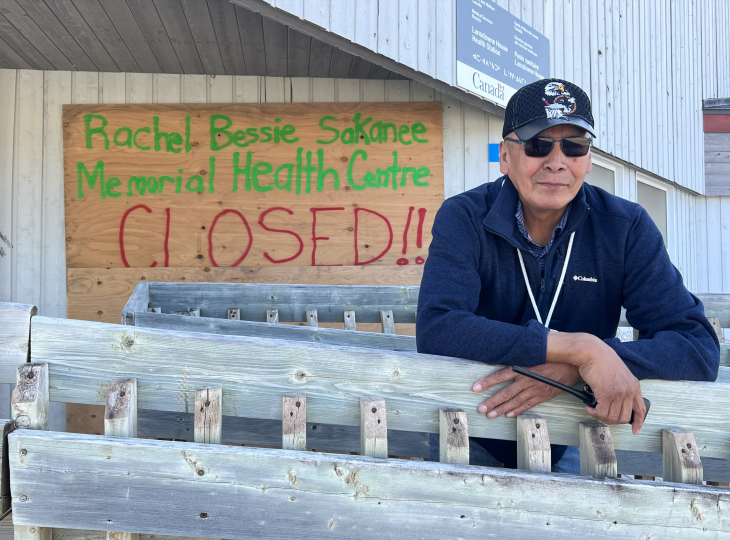
A fast snow melt this spring flooded the basement of the nursing station. When tests revealed fuel in the groundwater below the wet sand, council condemned the building. The community was evacuated in April, as 176 members stayed a month in Thunder Bay hotels.
The local telehealth worker who had an office in the health station has since been laid off, while dental hygienists have stopped visiting the community. Concern is growing that nurses are becoming weary of taking shifts in Neskantaga because they know the conditions they’re working under.
Meanwhile, the temporary health outpost in a residential duplex has no holding room, causing privacy concerns among patients. A vertical sheet divides the waiting room from the stretcher and drug supplies.
It’s mounting pressure on members to fly out in order to receive care of any kind. The ombudsman heard reluctance to travel may be causing some members to decline care they need. Even in those emergency care cases, priority airlift through Ornge has a minimum six-hour response time. Lower priority calls and scheduled flights take two days. Like most fly-in First Nations in northern Ontario, Neskantaga has no ambulance or local paramedics.
Neskantaga has an elder’s centre but there’s no medical or support staff to attend to their needs. Former chief Roy Moonias told Dubé many elders are being forced to fly out to Thunder Bay.
“Once you get older, you’re going to leave this community, go south and die over there,” he said.

Elder and former chief Peter Moonias has been living in Thunder Bay since doctors gave his wife a terminal diagnosis. He said the system evicted her across nearly 10 hotels in a span of two months and that he needs to constantly attend to filling the gaps in her residency and care.
“Finally, we got a place to stay. She told the doctor, ‘Send me home. I want to go die over there with my family.’ That’s what she told the doctor. ‘I can’t find a place here, I can’t live like this. I have a house in my home community.’ ‘It will never happen again,’ he said. Two months ago, we got kicked out again.”
Years before the crisis that shuttered the health station, former chief Chris Moonias worked there as a custodian. He recalled being instructed to check the blood pressure of patients and give results over the phone because no qualified staff was available.
“My parents died in Thunder Bay of loneliness because they couldn’t get care here,” he explained. “My best friend who died last year couldn’t come home. He was approved for dialysis and as soon as the doctor knew we were under a 30-year boil-water advisory, he said, ‘you can’t go home. It has to have good, clean water to operate the machine for dialysis.’ He always talked about wanting to go to Neskantaga one last time, but he couldn’t go back.”
The school is showing its age

The school, which was also built when the community was new in the mid-1990s, is showing its age. Students almost lost their year when the boiler broke down late last winter and with almost one in every three people on reserve being of school age, it can no longer hold the future’s potential.
Administrators say the building’s two-storey ceilings are impractical in this climate, where the heat rises over square footage that can’t contain the educational needs of the 80 children enrolled. Particularly outside the front door, the majestic wood architecture has begun rotting.
“On the outside, you may think it looks bigger but on the inside, it’s not,” said Geraldine Yellowhead, who teaches a Grade 7-8 split class. “When you come into our classrooms, there’s not enough space for our students.”
According to staff, half of local students are on the autism spectrum. Yellowhead says special education funding is desperately lacking and resources are needed if the language classes are to keep the culture alive.
Brand new teacher residences across the street show promise for attracting and retaining staff who aren’t from the community. But the school only goes up to Grade 8, with a Grade 9 class having pilot funding. Education leaders purchased the portable classroom that was shipped in on the ice roads last winter and is now under construction on the former basketball court in the schoolyard. They’re hoping the government will pay them back.
Leaving home
Neskantaga leaders unanimously want high school to be extended to Grade 12, like any other non-Indigenous education centre in northern Ontario. Because Canada doesn’t fund secondary education in fly-in communities like Neskantaga, its young people must travel to Thunder Bay to attend high school at the age of 13.
According to Nishnwabe Aski Nation Deputy Grand Chief Anna Betty Achneepineskum, an average of two students from NAN’s 49 communities die unnatural deaths in Thunder Bay each year. She advised Dubé to study the Seven Youth Inquest, a 10-month undertaking in 2014-2015 that examined the deaths of seven youth from NAN territory who died under mysterious circumstances while attending school in Thunder Bay.
“We need to start this moving, even if we have to tell the youth that the government doesn’t care. That’s what the youth say, they say ‘they’re going to take our land.’”
“It’s hard when you have a family, to send their child off to school with the best intentions of ensuring that their child gets an education, only to bring them home in coffins,” she told Dubé.
Yellowhead worries for her students, recalling her own time in the city.
“I was lonely. I cried myself to sleep. I was living with strangers – and I’m pretty sure that’s how it is today,” she said. “That’s one of the reasons why we need a new school, a high school, so we don’t send our kids off to strangers.”
Suicide crisis
That brought the tour to the cemetery, where traditional drum music blasted from one of the vans in the eight-vehicle convoy. The suicide crisis Neskantaga declared a decade ago still stands.
Twenty-three-year-old Wilda Sakanee took her own life in December 2023. She was living in community care in Thunder Bay and multiple agencies knew her to be struggling with alcohol and mental health.
“My belief is that nobody did anything about it,” said Stanley Moonias. “Community care knew she was so sad. The Thunder Bay police didn’t do anything, they knew she was suicidal. What would you do? You’d respond to suicidal ideation. I believe she was failed.”
Lashaunda Waswa is the youngest member of Neskantaga council. The 21-year-old described how she personally broke her kneecap doing parkour in the unsupervised arena, which hasn’t been functional enough to flood for years.
Waswa left home for Thunder Bay at the age of eight and said she survived two abduction attempts over the following two years at the hands of strangers.
She spoke for the youth through tears, tying the water issue to education to recreation and culture.
“We’re bready to break these cycles. We’re ready to make these changes. We need to start this moving, even if we have to tell the youth that the government doesn’t care. That’s what the youth say, they say ‘they’re going to take our land,’” she said.
“I don’t want to say ‘beg’ but I put down tobacco earlier today in hopes that the spirit will come into your heart, the government’s hearts – anybody – to guide you guys to give us a better life for our youth because nothing really has changed.”

Choosing life
When Dubé first arrived at Neskantaga’s airport, dozens of children greeted him with signs calling for all the above infrastructure. But what he didn’t see was how 30 kilometres down the Attawapiskat River, a third of their classmates were staying at Windsor Lake Camp, through a federally-funded suicide prevention program called Choose Life.
Neskantaga’s people insist they’ve always lived in cabins all along the Attawapiskat River. There were 10 cabins on this island in the 1950s, when marten trapping was more profitable and the commercial sturgeon fishery was at its height. They’ve been replaced by an all-season camp and bunkhouses for young people.
From smoking fish to birch bark crafting to cooking and sewing, adults and elders tended to their skills, while the children came around when they felt right.
Lawrence Sakanee is the land-based coordinator for this camp and another one north of the reserve on Lake Attawapiskat. He said there’s trauma in these cases of bottled water he unloaded from the freighter canoe that was bringing fresh supplies from the reserve. After 30 years under boil-water advisory, he explained, a collective trauma is causing young people who have never trusted the water to need the bottles, even out here. Even his own grandson, he struggled to admit, is skeptical and he sees it as separating them from the land.
“That water,” Sakanee said, pointing to the river, “They can’t drink it. I can drink that, but for them, they can’t drink it. After 30 years of boil-water, they don’t trust the water. That’s a problem. They think it’s contaminated here too.
I’m trying to teach them the best I can: water is life.”
Jon Thompson is a Local Journalism Initiative Reporter based in Thunder Bay. Contact him with tips and story ideas at Jon@ricochet.media.