On a dirt road above the Walbran, forest defenders maintain a vigil for what’s left of the old growth.
McLure Road is an hour and a half from Lake Cowichan, the last town before the trees close in for good. It runs west off the pavement and up into Pacheedaht territory, past clear-cuts stubbled with slash, until it forks toward a gate the logging company put up after it won a court injunction. Beyond that gate is what’s left of the Walbran Valley’s old growth — western red cedar and Sitka spruce that were standing before Confucius, before Christ, some of them.
Just short of the gate, off a side road climbing a small hill beneath a cut block, sits a cluster of tarps, a fire pit, and a few tents. They call it the watch camp. It isn’t a blockade. Not yet. For a month now, five to 10 people at any given time have been holding this ground, watching the logging trucks come and go, writing down license plates, filming, waiting.

It’s been five years since the summer of 2020, when land defenders first blockaded roads in this same stretch of forest and set off what’s now recognized as the largest act of civil disobedience in Canadian history — more than 1,100 arrests over two years, foot chases through the bush, helicopters, pepper spray, a movement that came to be known by the name of the watershed next door: Fairy Creek.
It has swelled and receded since. A camp called Savage Patch went up in 2023 and came down under RCMP escort, the blockade dismantled by the same machinery it was built to stop.
Last August, another camp went up nearby, in the Upper Walbran — a fence across the road at the gate, and behind it a wooden cougar carved from salvaged timber standing sentry over the old growth.
Pacheedaht Elder Bill Jones was there at dawn on the first morning, leading 30 people to block the fallers from eight newly approved cut blocks. Cougar Camp, they called it, and it held for nearly six months.
The company on the other side of that gate is Tsawak-qin Forestry Limited Partnership, a joint venture between Western Forest Products and the Huu-ay-aht First Nations — a name, critics like Jones say, that trades on Indigenous partnership while doing what Teal-Jones did at Fairy Creek.
In September, a B.C. Supreme Court justice granted the company an injunction, ruling that whatever the merits of the cause, the blockade itself was unlawful. By late November, RCMP had moved in, arrested six people, pulled protesters down out of tree sits, and dismantled the camp, cutting the last holdouts loose from the cougar sculpture they’d locked themselves to. Logging resumed within days.
Now they’re back. Watching, for now, instead of blocking — close enough to the same gate to see the trucks, careful to stay outside the terms of the injunction that ended Cougar Camp.
Riggs
Every morning around 5 a.m., Riggs and her partner set out on the roughly three-kilometre walk down to the gate. Towering hemlock and cedar lean in close on either side, the air still carrying the night’s damp. They sit, watch the trucks, and document what they see.
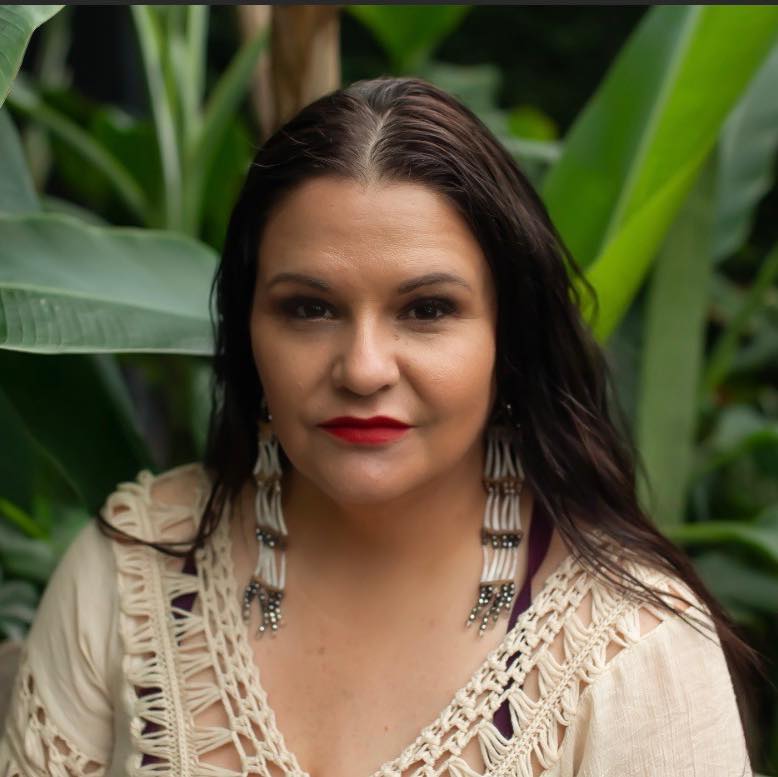
Riggs — that’s her camp name — is 42, a former train-hopper who’s been living out of a converted minivan at the camp for weeks. Inside, the walls are hung with tapestries; a stuffed owl watches from a shelf. Tattoos she gave herself cover her arms and legs — rivers, forests, a line from something she wrote once, all in her own hand. She’s smoking a joint before we talk, unhurried.

She grew up in Maple Ridge and Whonnock, introduced early to Indigenous culture in a way she says she’s grateful for, because her own family’s culture had already been lost.
Her connection to trees, she says, didn’t start as something spiritual. It started as survival. At five years old, in danger, she heard something she can only describe as a voice that doesn’t use words — an instruction, more than a sound. “The roots of the cedar tree is where I needed to be,” she says. “That’s where I was safe.” She went to the trees, again and again. At 14, after being raped, it was a cottonwood that spoke to her this time, telling her to get up off the ground. She walked for hours, alone, to a friend’s house outside Chilliwack.
“It hasn’t just been one time that this language has come to me, this protection has come to me,” she says.
What followed was methamphetamine at 14, then years on the road — train-hopping and hitchhiking across the country, the punk scene, the drinking. “I always saw punk rock as group therapy,” she says now, “but as I’m getting older, I see it was a way to safely punish myself.”
“There’s no old growth left on that mountain now,” she says. “That was the last of it.”
She had her first daughter at 23, then a second daughter not long after. However, the years of addiction that came before and after put distance between her and both girls, a rupture she’s still working to repair. She trained as a substance-abuse counsellor in Ottawa and worked alongside people on the street, in the years that fentanyl tore through that world. “There is only a few of us left,” she says of the friends she travelled with back then. “Suicide or fentanyl overdose.”
She’s sober from drugs now; sober from alcohol only four months, after a relapse that ended, she says, with her body purging the need for it entirely outside Hope, B.C., near the Skagit River. She calls it a gift.
Her first old-growth blockade was at 15, at Elk Mountain near Chilliwack — a camp that lasted six months before the fallers and the helicopters came in and took what was left. “There’s no old growth left on that mountain now,” she says. “That was the last of it.” Years later, she fought the Trans Mountain pipeline expansion near Hope, where a grove of cottonwoods she’d visited for a decade was clear-cut in a single push. Before the crews laid pipe through a river running with early salmon, she sat down in the water, bare feet and hands in the current.

“I said, ‘I’m here with you,'” she says. “‘You’ve seen me as a mother, you’ve seen me as a broken person, you’ve seen me as a warrior, and I’m here now to see you — and to witness what is happening, and to acknowledge the change that will come after this damage has been done.'”
She doesn’t call it justification, what she offers the people doing the cutting — only an understanding that most of them were never taught another way to see the forest. “They’ve never had somebody offer that connection and knowledge to them,” she says.
She describes what happens in her body when she’s deep in the old growth, among what she calls the wise ones — the trees old enough to have outlasted empires.
“It’s like a direct tether or a ley line to those conversations,” she says. “It’s an ability to feel nothing but the present. All of that disappears, and we are of spirit.”
Asked what’s driving the destruction itself, she doesn’t hesitate.
“I would explain it in a loss of spirit, a loss of culture, a loss of connection,” she says. “Because when we’re not open to having those conversations with the land, we don’t know — it’s not something that’s easily passed between people, especially if they’ve experienced their own trauma, the things that cause us to lose connection.”

She goes further — she believes the land still carries the wound of everything done to it since colonization began, and that the people doing the cutting are, in some way, drawn to hold that same darkness. “If it’s completely gone,” she says of the forest, “that would be surrendering to the very things that we need to heal.”
Asked if she believes any of this can still be saved, she doesn’t pretend. “I struggle with that big time,” she says. “Is it going to be another situation where I am here and I have been asked to just hold space for the land?
“It’s a constant struggle for me. Looking forward, if I’m not able to do anything, I am still available to hold that tree like that tree would hold me when I’m hurt.”
She once sat down between industry and the road during an enforcement action, not to block anyone physically, just to be seen. “At this point in my life,” she says, “I don’t want to hide my face anymore.”
Yogi Shambu
Stephen Daniluk goes by Yogi Shambu at the camp — a meditation coach and musician from Victoria, a drummer who’s toured and recorded with other people’s bands and now runs a small studio out of his own house.
He doesn’t look the part of a hardened frontliner; he looks like someone you’d pass on a hiking trail. But he’s been coming back to this fight since the fifth day of the original Fairy Creek blockade in 2020, on and off through the raids and the arrests, and he isn’t done.
He grew up in Lynden, a former sawmill town of 500 people outside Brantford, Ontario, surrounded by a sea of corn and soy where the pine forest used to be. “I was so drawn to the trees that were surrounding this massive ocean of monoculture,” he says.

As a kid he used to climb into the cedar hedges — “just as bushes,” he says, laughing. “It was very uncomfortable. I wouldn’t recommend it.”
He’s lived on Vancouver Island for two decades now, drawn, he says, by an ecosystem still whole enough to let something grow old and die on its own terms. “That complete life cycle of an ecosystem is, I believe, a very spiritual thing,” he says, “and it’s essential for us to return to the woods and be able to experience that.”
His first time occupying an industrial site was seven years ago, a month spent on Swanson Island with the Namgis First Nation, protesting salmon farms. At Fairy Creek, he settled into something like a camp role — helping newcomers who cared deeply but arrived with no bushcraft, no sense of how to actually hold a frontline.
“We’re children with an abusive parent,” he says of the broader relationship between land defenders and the state, “and that’s what I wish to help to mature.”
What keeps drawing him back, he says, is a kind of comparison he doesn’t make lightly.
“This is Canada’s ivory trade,” he says of the old-growth harvest. “We are engaged in that.” He recalls standing on a mountainside where a fresh clear-cut sat 82 degrees in the spring sun while, two hundred feet away, in the standing old growth, there was still snow on the ground. “The world needs more shade,” he says.
“This world is in its goodbye party.”
He repeats what he calls Bill Jones’s mantra to anyone who’ll listen, the invitation Jones has extended to strangers for five years running: “Come take a walk in the old growth, so that you can be with the mother.”
He’s watched that relationship turn ugly up close. At Fairy Creek, trailing an RCMP officer who didn’t know he was there, he saw the officer grab a young Indigenous woman and throw her into a ditch. “It broke my trust,” he says. “I don’t know how — I’m not through that journey of processing.”

He was present again in December, at the second RCMP enforcement action on the Walbran blockade, and watched roughly 20 officers move through camp “in formation,” extracting a woman suspended in a tree pod and an 85-year-old former logger — chained by bicycle lock to a wooden elk sculpture, osteoporosis and all — before the man climbed down on his own. “He chose to be there,” the RCMP’s team leader told Daniluk, when asked to consider the man’s age and his brittle bones.
Daniluk doesn’t think the outcome here is likely to be good. “I feel tragically that it will be lost, the majority of it,” he says of the old growth still standing in the Walbran.
He suspects the province and industry both know the end is close, and are moving to cut what’s left before it’s gone — before treaty settlements in the region are finalized, and before public attention returns.
“It seems almost spiteful,” he says of the pace of logging near the camp, closer to creeks, closer to the park boundary, since confrontations with defenders began. Still, he keeps making the drive from Victoria, keeps filming, keeps inviting people to come sit with him at the gate.
“This is a place for people who are moved and interested to meet and show their support,” he says. “Come camp with us as if life depended on it. That’s our invitation to you.”
Ricco
Ricco has been on and off these frontlines since 2021, when the fight to defend Fairy Creek began. She came out for what she thought would be one weekend and never really left.
She lives out of her van too, the fabric of camp life stitched into her days: watching, documenting, holding ground even when the camp’s own internal politics get tense. Long brown-and-grey hair, a cigarette always somewhere near her hand, and a tiredness that doesn’t read as defeat.
She was dragged off this territory in handcuffs once, in 2023. This year, in February, she left mid-vigil when she got a call that her sister might have died on Vancouver’s Downtown Eastside. She packed up, drove straight there, found her alive. “That’s all we can pray for,” she says.
Ricco, who is Cree and Austrian, grew up in Prince George, in what she calls a tree farm, and didn’t understand how altered that landscape was until she arrived on the coast.
“The first thing I told my son was, ‘I feel like I’m in a fairy forest right now,'” she says. “And then someone made a comment and said, ‘This is what forests are supposed to look like.’ That’s when I realized how heavy industry was up in Prince George — and how much I’d been taught from a young age that that was normal.”

This year, the camp’s strategy shifted toward evidence. “Every year I find people say, ‘Where’s the proof?'” she says. “So this year we did our homework. We got the proof.”
She describes a land guardian who let camp members set up near a tree she estimates at 1,400 years old — and a gate that appeared the next morning, guarding a bridge into what she believes is the last untouched patch nearby. She describes helicopter traffic louder than anything she’s heard on this frontline before, and new roads blasted through, she says, specifically to move trucks past the camp’s cameras.
She then points to an endangered marmot, recently found in the area, and to a security firm she says has admitted working alongside the RCMP.
A Hawaiian elder who visited camp recently asked her a question she couldn’t answer cleanly: why the rivers here don’t run anymore, why there’s no salmon on the fire. “I didn’t know how to explain to him, even with our original treaties, why the rivers have gone dry,” she says. “Then having to explain that it is through the excessive logging.”

She invokes prophecy — elders’ teachings about a fork in the road, one path toward land and love, the other toward the dollar sign, the snake. “They told us that the land would become unrecognizable,” she says of what the elders foretold. “But the part that wasn’t explained is that we have to move forward with love and education.” She sees the old growth in kinship terms that don’t leave much room for negotiation.
“Cedar is the people,” she says. “The people are cedar.” Taking the last of it, in her telling, sits alongside other historic losses.
“It’s a part of genocide, just like they took the buffalo,” she says. “They took every last buffalo to get rid of us. And now on the West Coast, they’re taking every last tree.”
She describes the Earth itself in bodily terms — “the grass is the hair of our mother,” she says. “The rivers that flow are the blood of her veins. The oil is the lubrication to her joints.” There’s a limit to what a body can lose before it fails, she says, human or otherwise. “There is no plan B.
“We keep talking about these times of prophecy,” she says. “We’re in that time now.” Her uncle once told her the real work might be at home, not on the frontline. “Go home, my niece,” she remembers him saying. “Work with your children, because those children are our future.”
She still came back to the watch camp. Both things, she says, are true at once.
Elder Bill Jones
Bill Jones is 86 now, his once shoulder-length hair cut short and white, a cane in one hand as he sits in a folding lawn chair in a clearing far past the watch camp, deep enough into the Walbran that cell service doesn’t reach.
He’s made the drive out from his care home in Sooke, with a volunteer, to visit — first the watch camp, briefly, then further still, to a remote gathering where scientists and forest defenders have come for the weekend to document marbled murrelets, an endangered seabird that nests only in old-growth canopy.
Jones worked in the logging industry himself, until October 1984, when he was laid off. He remembers the personnel manager’s response when he asked how long the layoff would last.

“Come back in three hundred years,” Jones was told — the man laughing, he says, “insanely.” Jones asked if his unemployment insurance would still be running by then. The man laughed harder.
He speaks now with a bluntness that spares no one — not industry, not the provincial government, and not his own nation’s elected leadership, which has entered into revenue-sharing agreements with logging companies that Jones has spent years publicly opposing.
Pacheedaht and neighbouring Ditidaht have been negotiating a modern treaty with Canada and B.C. for more than two decades, one of dozens of such talks underway across the province.
In 2019 the two nations signed an Agreement in Principle, and their table has since advanced to the final stage of negotiation — the last step before a nation votes on whether to ratify. A finished treaty typically brings a cash settlement, transferred land, and recognized self-government, but it also means giving up certain claims tied to unresolved Aboriginal title.
“It’s grim here,” he says. “We’re on the last of the old growth in this area, and the last of the protection of the marbled murrelet.”
Jones describes his band as trapped in debt from a multimillion-dollar sawmill upgrade, and views the coming treaty vote with open suspicion — a payout, he believes, designed to secure support for a deal that would leave the nation deeper underwater once its debts are weighed against the settlement.
“The only way out I perceive,” he says, “is to say, ‘Okay, no, we don’t want the treaty.'”
He doesn’t offer easy comfort about whether the forest can still be saved. “It’s grim here,” he says. “We’re on the last of the old growth in this area, and the last of the protection of the marbled murrelet.”
He describes industry’s final push through what remains of the valley in terms that leave nothing standing outside the blast radius — the animals, the ecology, “everything in the forest has been disregarded as collateral damage.”

He compares it to “drunks in a bar fighting over the remaining drinks that they have,” and when asked who might stop them, he answers himself, “We have to be the bouncer,” he says.
He speaks of the Earth as something older and more patient than the industry consuming it, a force that has outlasted ice ages and will outlast this one too.
“She will simply recreate and create another ice age that will put into its grave mankind’s destruction of her kingdom,” he says. “This world is in its goodbye party.”
The animals, the ecology, “everything in the forest has been disregarded as collateral damage.”
But he has something to say to the people holding the watch camp, too — instruction more than consolation.
“They are our recruitment people,” he says. “They are here to recruit the world to show the world that we have to save what’s left of the old growth, and they are the spearhead.” His advice to them is specific: stop any infighting, cleanse themselves at the creek with cedar boughs or sage, and remember what they represent.
“The non-contaminated messengers,” he calls them. “The last guardians of our old growth.”
A camp closes, the line moves to the gate
Four days after I leave the watch camp, I reach Glenn Reid by phone. It’s 7 a.m., and he’s standing near the industry gate, where a handful of land defenders locked themselves down at 3:30 in the morning. Reid is a media representative for the movement and one of its longest-standing members, out here since the beginning in 2020. He’s been up all night.
Five people chained themselves to the gate before dawn. Industry showed up half an hour later. When RCMP finally arrived around 6:30, the group had already slipped loose and scattered into the trees — an old trick, part strategy and part theatre, meant to leave the gate empty and the industry’s 911 call looking pointless by the time officers pulled up. “We’re not here to enforce anyways,” Reid says the officers told the empty road. Fifteen people showed up in total that morning, and a Global News crew filmed it live, he says. “We gotta do all we can to embarrass the government into doing the right thing,” Reid says, echoing something he’s heard Bill Jones say more than once.

Something else happened at the gate that morning, too, unplanned. A barred owl landed on the sign that reads “GATE AHEAD” and stayed close for 20 minutes, watching the group work, before it drifted back into the trees. “It was a true encounter,” Reid says.
But the watch camp described earlier in this story — the tarps and tents on the hill, the 5 a.m. walks down from it — no longer exists. Bill Jones and a group of elders ordered it closed, officially because of concern for a marmot denning nearby, but Reid doesn’t pretend that’s the whole story.
The camp had drifted from where it was supposed to be, and in the weeks before it closed, it had come apart in quieter ways too: people cycling in and out, alliances shifting, one member in a mental health crisis whom others say threatened people and vandalized a vehicle — trouble serious enough that another defender asked a campmate to stand guard in case things escalated further.
“You can’t have people that sick on the front line,” Reid says. “And you can’t approve of it. You can’t. That’s dangerous.”
It’s a part of frontline life that rarely makes it into the telling — the spiritual conviction is real, but so is the exhaustion of holding a rotating group of strangers together for months at a time, in the rain, with no walls and no break from each other.
Personality clashes flare and cool. People get asked to leave and come back. Grief and trauma that brought someone to the forest in the first place don’t stay outside the tent flap. Everyone out here will say, in one way or another, that the fight against industry is the easier one; the harder work is holding each other together long enough to keep fighting it. Jones’s message to whatever comes next is blunt on this point: any future camp needs to be set up “with matriarchs and elders of the territory,” not around them.
For now, there’s no fixed base at all. Defenders will car-camp in the open field near the gate and gather before dawn to block it, day after day, with no shelter beyond what fits in a vehicle.
“Every single morning there’s gonna be someone here arrested,” Reid says of the new commitment — though on this particular morning, nobody was. Whether that changes tomorrow, or the morning after, is the only question anyone at the gate seems to be asking.
Two ways of counting a forest
Underneath all of it is a dispute over what “old growth” even means. The B.C. government defines it by age alone — coastal trees over 250 years old — and says roughly 39 percent of Vancouver Island’s forested land, about 770,000 hectares, still qualifies, with some 80 percent of that protected in parks or no-harvest zones.
Scientists and groups like the Ancient Forest Alliance and the Wilderness Committee say that framing buries the real story. Lumping stunted, low-value bog and subalpine trees in with the towering, biodiverse giants of valley-bottom forest, they argue, lets the province claim protection for the least contested wood while the rarest, most productive stands — the ones that support the most life and hold the most carbon — keep falling.
By their count, high-productivity old growth makes up perhaps three per cent of what remains provincially; the very largest valley-bottom ecosystems have been reduced to roughly 35,000 hectares in all of B.C.
On Vancouver Island specifically, more than 80 percent of that high-productivity old growth is already gone, including up to 90 percent of valley bottoms — the kind of forest still standing, for now, in pockets of the Walbran.
“Every single morning there’s gonna be someone here arrested.”
An independent Old Growth Strategic Review commissioned by the province itself found merit in those concerns, concluding B.C.’s policy fails to protect representative ecosystems.
Logging deferrals meant to pause harvest in the highest-risk areas depend on consent from local First Nations — consent tied, in turn, to revenue-sharing agreements that fund housing, infrastructure, and services in communities the province spent a century cutting off from other options. It’s the bind Bill Jones describes from the inside: a nation asked to choose between the forest and the mill payments it can’t yet afford to walk away from.
None of that arithmetic answers the question sitting at the end of McLure Road. It doesn’t tell Bill Jones what to do about a band council he no longer trusts, or Ricco what to say to a Hawaiian elder asking why the river’s gone dry, or Riggs what to do with a grief that doesn’t have anywhere left to go.
The injunction that cleared Cougar Camp in November is still on the books. Nothing legally stops it from being used again — against the people gathering at the gate each morning now, car-camped in an open field, with no fixed structure left standing for the RCMP to dismantle.
They know that. It’s part of why there’s no camp left to defend, only a line to show up to, again and again — a shift Bill Jones pushed for, and one meant to buy a little more time before the next raid has anything to burn. Jones has already told them what he thinks that time is for. Not rest. Recruitment. He wants the world looking at this gate, even as the fallers already move past it.